Tuesday, September 28, 2021

Phillies 1959: The Year of the Great Freese

The 1959 Philadelphia Phillies were a bad team. Perhaps even worse, they didn't offer a young fan much to root for. The stars of the Whiz Kid days were fast fading and the front office had failed to replace them with any significant, exciting talent. The top pitchers were Gene Conley, recently acquired from the Milwaukee Braves, and surly Jim Owens, perennial prospect finally having a decent season in the majors. The top hitters were Ed Bouchee, a year and a half past his conviction on a morals charge, and left fielder Harry Anderson, who had a breakout year in 1958, but who was about to experience a breakdown year in 1959. Into this void stepped an unlikely hero: 25-year-old, journeyman infielder, Eugene Lewis (Gene) Freese.

Freese was acquired from the St. Louis Cardinals at the end of the 1958 season for veteran infielder Solly Hemus. The Cardinals wanted Hemus to be their manager and so they sent Freese to the Phillies to obtain his rights. Freese had been in the majors for four years, having come up with Pittsburgh in 1955. He had shown some pop in his bat and some suspect defensive skills, but had never established himself as a regular. The Pirates dealt him to the Cardinals in June 1958 for Dick Schofield. Freese played all over the infield for the Cardinals, hitting .257 with six home runs. When the Cards decided to hire Hemus, Freese was thought very expendable.

In spring training with the Phillies, Freese was given the opportunity to win the third base job. Many pundits predicted he would be the opening day third baseman, but defensive concerns relegated him to the bench behind the incumbent, aging Whiz Kid Willie "Puddin' Head" Jones. In the second game of the season, Freese made his debut for the Phillies as a pinch runner for Jones in the ninth inning of a game at Milwaukee on April 14, and scored the game tying run on a triple by Wally Post.

In his next appearance the legend of Gene Freese began in earnest. On April 18, the Phillies were in Cincinnati to play the Reds. In the top of the third inning, with the Phillies leading 4-3, Freese was sent up to pinch hit for Phillies' starter Seth Morehead. It was Freese's first at bat as a Phillie. The bases were loaded. Left-handed rookie pitcher, Mike Cuellar, making his major league debut, was on the mound. Freese launched a Cuellar offering well over the left field wall at Crosley Field for a grand slam home run. The Phillies went on to win the game, 14-9.

Freese did not appear in a game again until five days later on April 23 at Connie Mack Stadium against the Milwaukee Braves. In the ninth inning of that game, with the Phillies down 3-1, Freese was sent up to pinch hit for Phillies' catcher Valmy Thomas. Joe Koppe was on first base. The Braves pitcher was lefty Juan Pizarro, who had held the Phillies to just one run and four hits to that point. Freese worked the count to 3 and 2 and then launched a deep fly ball into the seats in left to tie the game. Two outs later, Granny Hamner also homered and the Phillies had a walk off win.

The next day the newspapers had dubbed Freese, "Mr. Wonderful" for his pinch hitting heroics. Freese's performance earned him a couple of starts at third base, but he was still a bench player for the most part in this early part of the season. On May 11, Mr. Wonderful struck again, homering off Art Fowler of the Dodgers at the Los Angeles Coliseum in the eighth inning to tie the score at 10. The Phillies eventually lost the game 11-10. 

On May 22, Freese had a two-run pinch homer off the Braves’ Lew Burdette, in the seventh inning of a 10-5 Phillies loss. Then on May 31, his eighth-inning pinch home run off the Braves’ Warren Spahn, was the only run the Phillies could manage in a 2-1 loss. To sum up, by the end of May, Freese had batted just 29 times, but had clubbed five home runs and driven in 13 runs, all as a pinch hitter.

Young Phillies fans were learning to clasp their transistor radios closely to their ears whenever Gene Freese came to bat. Apparently the Phillies front office was learning what they had in Mr. Freese. On June 5, they traded Willie Jones to the Cleveland Indians for outfielder Jim Bolger and Gene Freese became the regular third baseman for the Phillies.

Inserted into the starting lineup, Freese continued to hit the long ball. On June 14 in the first game of a doubleheader, his three run home run capped a six run rally that helped the Phillies come back from a five run deficit to beat the San Francisco Giants, 7-5. In the second game, he drove in three more runs as the Phillies swept the Giants, 6-3. On July 2, he hit his second grand slam of the year, this time at home against the Reds Jim Brosnan to help the Phillies win 7-6. And then, incredibly, on July 9, he smacked his third grand slam of the year. This one was the big blow as the Phillies crushed the Cardinals 11-0 at Connie Mack Stadium.

For one summer Philly had Freese Fever. On a team going nowhere but to the bottom, the exploits of Mr. Freese gave everyone something to cheer about. Freese finished the year with solid numbers. Despite being limited to 400 at bats, seventh on the team, he led the team with 23 home runs, and his 70 RBIs trailed only Post and Bouchee on the team. His batting average for the year was .268. Freese was a defensive liability at third base, however, leading all third basemen with 22 errors in just 261 chances for a .916 fielding percentage.

In December of 1959, Phillies general manager John Quinn traded the popular Freese to the Chicago White Sox. Phillies fans were outraged. The Phillies top slugger, their pinch hitting hero, their Mr. Wonderful, had been traded for some untested 20-year-old rookie right fielder. Eventually, the furor would die down because that rookie was none other than Johnny Callison, the first building block of the very good  Phillies teams to come and one of the most popular Phillies players ever.

Gene Freese bounced from the White Sox to the Cincinnati Reds, where he was a key part of the Reds 1961 pennant winners, bashing 26 home runs and driving in 87. A severe ankle injury in spring training in 1962 limited his playing time thereafter. After 1961, he never played in 100 games in a season again. He journeyed from Cincinnati, back to Pittsburgh, and then back to the White Sox before concluding his major league career in Houston in 1966.

For one summer in Philadelphia, however, the big bat of Gene Freese was just about the only exciting baseball story in town.




Tuesday, September 21, 2021

Ted Kazanski: The Phillies $100,000 "Can't Miss" Bonus Baby Who Missed

Phillies scout Eddie Krajnick had been keeping tabs on a young Detroit shortstop by the name of Ted Kazanski since he was fourteen-years-old. Other Phillie scouts had been impressed with Kazanski's play in the summer Vermont League. Ted Kazanski was the most sought after young player in baseball in 1951. The Boston Red Sox and Detroit Tigers were thought to be the leading contenders. The New York Yankees and Cleveland Indians were also in the mix. Nobody mentioned the Phillies much. Krajnick got word that Kazanski would sign with a major league team the day after he graduated from high school. Kazanski's step father, John Dziurda, was fielding offers.

Krajnick put in a phone call to Philies team president Bob Carpenter. "Better make it quick," he told Carpenter. Carpenter flew in his own plane out of Wilmington, DE Airport accompanied by his Farm Director, Joe Reardon. At 12:15 on the Monday after Kazanski's graduation, Carpenter, Reardon, and Krajnick met with Kazanski and his stepfather. Other scouts from other teams had already been there. Carpenter shook Dziurda's hand and said, "I'm willing to sign your boy at any price." The price turned out to be something north of $80,000 and probably close to $100,000. It was more than $25,000 above any other offer. Three hours later, seventeen-year-old Ted Kazanski was a Phillie.

What did the Phillies get for their money? According to Stan Baumgartner, writing in the Philadelphia Inquirer, baseball experts said that Kazanski was "the best looking shortstop to come into the majors in 25 years." He was dubbed "the next Marty Marion." Marion was known as "Mr. Shortstop" during his years with the St. Louis Cardinals in the 1940s.

Phils manager Steve O'Neill said Kazanski had "the fastest hands" he had ever seen. He also has one of the "strongest arms in baseball" and can make the difficult plays in the hole that a shortstop must be able to make. At the plate, his power had not emerged as of 1953, but his batting average was steadily improving in the minor leagues. Baumgartner concluded that he was "a big strong boy that could become one of the great short-fielders of all time if brought along smartly."

For his part, Kazanski was modest about his abilities. "I'm not really a good fielder. I make too many errors." He played down any talk about his potential as a long ball hitter. "I just hope I can make good in any league the Phillies send me."

The Phillies put him first at Class B Terre Haute where he hit .216 in 88 games. He hit .254 at Class A Schenectedy the next year and earned a promotion to the Phillies' top farm club in Baltimore for 1953. He hit .290 in 60 games with Baltimore and was brought up to the major league club on June 25 and inserted in the starting lineup. To accommodate the 19-year-old rookie, veteran Granny Hamner was moved to second base.

Kazanski's first game in a Phillies uniform was the stuff of dreams. Batting leadoff, he had three hits in six at bats, including two doubles and four RBIs. Those four RBIs set a record (since tied) for a player in his major league debut. In the field, Kazanski fielded nine chances flawlessly and was instrumental in two double plays as the Phillies crushed the Chicago Cubs 13-2 at Wrigley Field.

Alas the good times didn't last. By the end of the season Kazanski was hitting .217, with just two homeruns and 27 RBIs in 95 games. Even worse, Kazanski was not a major league shortstop. Pundits were noticing that he was often caught flat-footed and he didn't have the needed quickness to get a good jump on the ball. Kazanski spent most of 1954 on the Phillies bench appearing in just 39 games with 104 at bats and a .135 batting average. 

Kazanski was in the minor leagues for  most of 1955. Called up in September, he managed a highlight. On September 25, playing in the Polo Grounds, Kazanski became the first player in major league history to hit an inside the park homerun in the same game where he also started a triple play. The inside-the-parker was the only major league hit Kazanski got that season. The triple play, started by Kazanski at shortstop when he snared a line drive, ended the ball game. The Mets' Angel Pagan equaled Kazanski's feat on May 18, 2010.

The Phillies gave Kazanski one last trial in 1956. He started the season as the team's regular second baseman. He hit .211. He hung on with the Phillies for two more seasons as a utility infielder, but in 1959 he was traded to Milwaukee in a six player deal that sent catcher Stan Lopata to the Braves for pitcher Gene Conley and shortstop Joe Koppe. "They gave up on me," Kazanski told the Philadelphia Bulletin's Sandy Grady. "They decided I'll never make it." He never did make it back to the major leagues. Kazanski spent six additional years in the minors before calling it quits in 1964 at the age of 30.

Why did this can't miss prospect miss? Perhaps the Phillies rushed him to the big leagues too quickly. Perhaps all the "baseball experts" were wrong. Carpenter summed it up this way, "I thought he was the best high school prospect I ever saw. And the money didn't hurt his desire. He never stopped trying. He's just one of those mysteries." 

It is one of those mysteries that the Phillies franchise is still trying to solve as more recent can't miss prospects like Mickey Moniak, Cornelius Randolph, and Alec Bohm struggle to establish themselves as major league players.

Sources

In order to write this post I referred to articles in the Philadelphia Inquirer, the Philadelphia Bulletin and Baseball Digest. I also consulted baseballreference.com and retrosheet.com

Tuesday, September 14, 2021

Herrnstein to Wine to Herrnstein to Triandos: '64 Phils Turn Unique Triple Play

Phillies' Gus Triandos tags Colts' Rusty
 Staub to complete the triple play.
Things were looking mighty bright to the young Philadelphia Phillies team in the spring of 1964. Many pre-season prognosticators had chosen them to take the National League Pennant. Dick Allen, the rookie third baseman, was proving to be the real deal. Newly acquired ace pitcher, Jim Bunning, showed he would anchor the otherwise young staff and had already compiled a 3-1 record. Entering a game with the Houston Colt .45s at Colt Stadium on Sunday evening, May 17, the Phillies were 16-10, tied for second place with the St. Louis Cardinals, one-half game behind the league leading San Francisco Giants. 

During this contest the Phillies would pull off a triple play that would prove to be the crucial play in their 2-0 victory. Triple plays, of course, are rare occurrences, but this triple play was the rarest of the rare: a 3-6-3-2 triple play. A play that was unique in the history of baseball up until that time and a play that has been repeated only once in the 56 years since that day. 

The starting pitcher for the Phillies was Chris Short. Short was making only his second start of the season. He had begun the season in the bullpen and had not yet become the left-handed yang to Jim Bunning's ying. After this game he would take up a regular spot in the rotation and pitch very well all season. Opposing Short was Houston right-hander Jim Owens, a former Phillie with a reputation as a brawler and late-night carouser, who was trying to revive his career with the expansion Colts.

The Phillies lineup featured young and promising players at almost every position. Only left-fielder Wes Covington was over 30-years-old. Around the infield was Allen at third, Bobby Wine at short, Tony Taylor at second, and rookie John Hernnstein at first. Covington was in left, Tony Gonzalez in center, and budding star Johnny Callison in right. Clay Dalrymple was catching. 

The Phillies took a 1-0 lead in the top of the third inning on back-to-back doubles by Callison and Covington. The score was the same when the Colt .45s came up in the bottom of the fifth and all sorts of craziness ensued. Colt's first baseman Rusty Staub led off with an infield single and moved up to second when Walt Williams' sacrifice bunt was fumbled by Allen for an error. With two men on, Jerry Grote attempted to bunt twice and failed. Short then threw one low and the count moved to 2-2. At this point, Short threw another pitch around the knees that was called a ball by home plate umpire, Lee Weyer. Dalrymple said something to Weyer and Weyer tossed the Phillie catcher out of the game. 

Incensed, Dalrymple got right in Weyer's face and held up five fingers to indicate how many pitches the ump had missed. Manager Gene Mauch came out to both defend and protect his catcher and also got the heave-ho. While Dalrymple and Mauch marched to the clubhouse, Gus Triandos donned the catching gear and took Dalrymple's place behind the plate.

With peace restored, Short fired a 3 and 2 pitch to Grote, who slashed a ground ball to Hernnstein at first base. John caught the ball and fired to Wine to retire Williams for the first out of the inning. Herrnstein sprinted back to first base to receive the return throw from Wine, which just nipped Grote coming to first. Hernnstein lost his balance on the play, however, as he felt for the first base bag. Staub, seeing Hernnstein stumble, hesitated and then took off for home. Hernnstein recovered and threw to Triandos in time to catch a sprawling Staub at the plate.

The 3-6-3-2 triple play was, as I said above, the first ever in major league history. It was the first and last triple play of any kind at Colts Stadium, which was replaced by the Astrodome in 1965. It was also the first triple play the Phillies had pulled off since June of 1958. The play helped preserve the Phillies lead and Short's shutout. The Phillies scored their second run in the sixth, when Gonzalez walked, moved up on an error, and scored on a Taylor single. Short finished off a five hit shutout in style with the help of two double plays started by Taylor. Owens was the hard luck loser.

The man in the middle of the 3-6-3-2 triple play, John Hernnstein, had been a Phillies minor league prospect for a number of years and had two brief September call ups in 1962 and 1963. He was being heavily counted on in 1964, even though the other Phillies' rookie, Allen was much more highly touted.  Hernnstein started out well, and by the time this game was played on May 17, he was hitting .333 and had supplanted veteran Roy Sievers as the starting first baseman. The good times didn't last, however, and as Herrnstein's batting average plummeted, the Phillies looked to shore up their pennant chances by trading a couple of pitching prospects for Mets slugger Frank Thomas. By the end of the season, Hernnstein was relegated to pinch hitting and late-inning defensive replacement duty. He saw limited action with the Phillies in 1965, bounced around to three teams in 1966, and was gone from baseball thereafter.

Catcher Dalrymple was the only Phillie player not entirely ecstatic about the triple play. "I'm mad," he told the Philadelphia Daily News' Stan Hochman, "I could have been part of a triple play for the first time and I got thrown out of the game." As it happened, Dalrymple never was a part of a triple play in his 12 year major league career. He was on the field, however, on August 15, when Phils' pitcher John Boozer started a 1-6-3 triple play against the Mets at Shea Stadium and on October 2, when the Phillies pulled off their third triple play of the season, in Cincinnati against the Reds. That play helped the Phillies break their 10 game end of year losing streak. Chris Short was the pitcher that day, too. But there was little joy for the Phillies after that game, as their pennant hopes appeared to have slipped away.

The only other 3-6-3-2 triple play in Major League Baseball history occurred on August 5, 1998, when the New York Mets turned one - John Olerud to Rey Ordonez back to Olerud to Todd Pratt - at Shea Stadium. Barry Bonds tried to score from second on the play and was tagged out by Pratt..


Tuesday, September 7, 2021

Wes Covington: The Phillies First African American Star

Baseball historians will tell you that in 1957 the Philadelphia Phillies became the last National League team to integrate when infielder John Kennedy, a veteran of the Negro Leagues, pinch ran in a game on April 16. But Kennedy was only with the team for  five games and two at bats when he was sent down to the minors. From 1957 to 1960, several players of color played for the Phillies including Chico Fernandez, Pancho Herrera, Humberto Robinson, Valmy Thomas, Tony Taylor, Tony Gonzalez, and Ruben Gomez, but these players were either Hispanic or in Thomas' case from the Virgin Islands. The first African American player to have a significant role on the Phillies was John Wesley (Wes) Covington. 

When Covington joined the Phillies in a trade with the Kansas City A's for centerfielder Bobby Del Greco on July 2, 1961, he was already a major league player of considerable repute. Covington had played a significant role in the Milwaukee Braves World Series Championship in 1957 and in their pennant winning 1958 season. Not known as a great outfielder, he made two game saving catches in the 1957 World Series. In 1958 he hit .324 with 24 home runs and 74 runs batted in in just 90 games. He received some MVP votes that season. But his offensive production fell off in 1959 and 1960 and injuries further eroded his defensive abilities. After an acrimonious holdout in the spring of 1961, Braves management soured on him. 

In May of 1961, the Braves left Covington exposed to the waiver wire, where he was claimed by the Chicago White Sox. After just one month with the Sox, where he hit .333, he was traded to the  Kansas City A's in an eight player deal. He didn't even last a month in KC when he was traded to the Phillies. Four teams in one season puts Covington on a fairly exclusive list, but his was able to settle down when he got to Philadelphia.

The Phillies he joined were an awful team. Under second year manager Gene Mauch, the rebuilding Phillies would find a way to lose a major league record 23 straight games in July and August. Covington's arrival was greeted by fans as a breath of fresh air. Although in the words of general manager John Quinn, Covington was "no gazelle" in the outfield, his potent bat was most welcome on a team that featured a bunch of generally punchless .250 hitters.

Part of Covington's appeal was his intimidating pose in the batter's box. Coming up to bat, Covington would take his time, scooping some dirt into his hands, adjusting his cap, knocking dirt from his cleats, outlining the batter's box with his bat. He would then set his feet wide apart in the box and lean way back on his back leg, as if a gale force wind was blowing against him. Finally, he would dangle his bat over his shoulder level to the ground like a polo mallet and make a few menacing loops with it in the air. It was quite a performance and his stance was imitated by Little Leaguers throughout the Philadelphia area much to the consternation of their coaches.

However eccentric the stance might be, it was productive. After a slow start, Covington began to rake line drives all over Connie Mack Stadium. On July 21 he was hitting just .227. By August 27, he was hitting .352. and was rapidly becoming a fan favorite. In 15 games against his old mates in Milwaukee, he hit a cool .375. On July 28, at Connie Mack Stadium against the San Francisco Giants, Wes launched a three-run homerun in the first inning off the Giants Bobby Bolin, and followed that up with a solo shot in his next at bat in the third inning. Unfortunately, Covington was pretty much the whole show as the Phillies and Art Mahaffey went down to defeat, 8-5.

Covington had a particular affinity for the high, metal right field fence at Connie Mack and would frequently ping line drives off of it or launch home run shots over it. Fans would come to games early just to see Wes take batting practice.

Covington had five productive seasons with the Phillies slashing .284/.373/.471 and he remained a key contributor to a team that continued to get better and which came so agonizingly close to a pennant in 1964, before they collapsed with a ten game September losing streak that saw them cough up a 61/2 game lead. Covington himself hit just .150 with no home runs or RBIs in those ten games. He made no friends with management after the season when he went around town pointing fingers of blame for the collapse at everyone but himself.

Despite overall good numbers, Covington had a fraught relationship with manager Gene Mauch. Covington bristled under Mauch's platoon system that saw him out of the lineup when the Phillies faced a left-handed pitcher. Never shy about expressing his feelings, Covington talked freely to the press about his frustration. Mauch responded that Covington was prone to both "pop off and pop up." It didn't help that as he got older his outfield defense continued to erode. After the 1965 season, he was traded to the Chicago Cubs for pinch-hitter Doug Clemens.

Despite the unhappy ending of his time with the Phillies, Wes Covington was a groundbreaker for the Philadelphia franchise. An established star when he arrived, he delivered consistent offense for a rising team and clubhouse leadership for the younger players. As the first African American to play a significant role on the team, he paved the way for future African American stars like Dick Allen, Dave Cash, Gary Maddox, Jimmy Rollins, and Ryan Howard. On a team with a poor history of race relations, Covington's imposing presence was an important step in the right direction.


Tuesday, August 31, 2021

Telling Former Phillie Russ Wrightstone's Story

Russ Wrightstone played for the Philadelphia Phillies from 1920-1928. He was a pretty good hitter. No less an expert than Casey Stengel, a former teammate, called him "the best left-handed line drive hitter I ever saw." Grover Cleveland Alexander called him "the toughest man to get out in the National League." For his career with the Phillies he slashed a more than decent .298/.350/.492 in 899 games. 

I had the opportunity to write Russ Wrightstone's biography for the Society for Baseball Research (SABR) BioProject. The project is gathering 4,000 word biographies for all the players who ever played in the major leagues. It is a huge and on-going project that I am happy to be a small part of. I have written nine biographies to this point.

In beginning the research for these biographies, one of the first things I do is write to the Baseball Hall of Fame in Cooperstown to get the file they maintain on every major league baseball player. The files contain death certificates, scouting reports, old contracts, newspaper clippings, etc. Russ Wrightstone's file contained something a bit unusual. It was a letter written in 1969 by Wrightstone's 22-year-old grandson, Dennis Corby, to Hall of Fame historian, Lee Allen, two days after Wrightstone's death. The letter had sat in this file for 50+ years. It was, in part, a plea for some recognition for his ball playing grandfather. Dennis wrote in part:

I don't know if you are familiar with grandpa's records or not - today few people remember his accomplishments, but I do believe that many of  his old teammates definitely remember him. For this reason I ask that you possibly research his career and devote some space to him in your "Cooperstown Corner" column in The Sporting News. I pleaded with [The Sporting News] for several years to do a story on grandpa while he was living so that he might finally receive recognition and that he might be boosted mentally, but [The Sporting News] refused. I do not ask now for recognition or a resuscitative laudatory - the man has not lived to see that, but I ask for a short notice which he, at least, deserved - a memorial to Russ Wrightstone, a man who played hard, lived so moderately, and a baseball lover 'til eternity.

Dennis Corby's 50-year-old plea affected me profoundly. I decided to see if I could find him and talk to him about his grandfather and I determined that my biography, though years too late, would stand as that memorial to Russ Wrightstone. Through some internet sleuthing, I found a Dennis Corby who was still alive, was formerly from the Harrisburg area, and was currently residing in Fullerton, CA, where he worked as a financial advisor. I thought this must be the author of the letter but I wasn't sure. I wrote to the Fullerton address I had, included my contact information, and crossed my fingers. Sure enough a week later I got an email from "Denn" Corby, Russ Wrightstone's grandson, thanking me for my letter and saying he was eager to talk to me. 

A week after that we had a one-hour telephone call where Denn shared his memories of his grandfather and where the two of us bonded over our mutual love of baseball and our fond interest in Russ Wrightstone's career. Denn shared stories of his grandfather's devotion to baseball and how he was always dropping by the sandlots in the West Shore area near Harrisburg to share his knowledge of the game with youngsters. Sometimes he would bring friends who happened to drop by for a visit with him. On one memorable occasion, Russ showed up with a friend whom he did not introduce. The friend offered some hitting tips. Only later did Denn learn that this friend was none other than Hall of Fame outfielder, Paul Waner. Former major leaguers were always dropping by to visit Russ Wrightstone.

Denn shared how his mother, Betty Wrightstone Corby, was a "dugout baby," often accompanying her father to spring training in St. Augustine, Florida and hanging out in the dugout with visiting players like Babe Ruth and Lou Gehrig. While Russ was on the field practicing, other players would provide babysitting services. Denn also told me about Russ' son, Bob Wrightstone, a talented player, who pitched briefly in the St. Louis Cardinals organization. Both Bob and Russ were also accomplished golfers who competed successfully in local tournaments.

The affection Denn Corby had for his grandfather came through loud and clear on the telephone. It enhanced the biography I was writing immeasurably. I was proud to be able to tell the story and fulfill a 50-year-old wish. Russ Wrightstone died in 1969 after a 10 year battle with leukemia, but he left behind a grandson determined that his hero would be remembered.

The stories that baseball allows us to tell, both of the famous and the not so famous are limitless. You can read my SABR biography of Russ Wrightstone here.


Tuesday, August 24, 2021

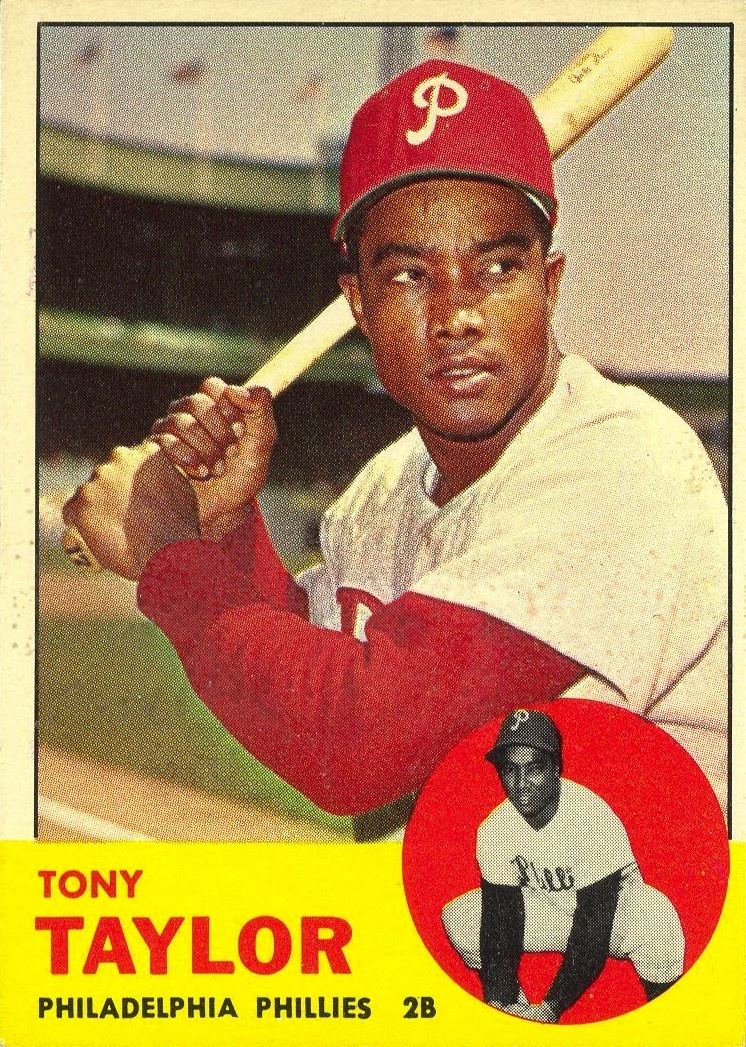
Tony Taylor: Phillies Lone All Star in 1960

When the Phillies acquired the 24-year-old Cuban, Antonio Nemesio (Tony) Taylor, in a May 1960 trade with the Chicago Cubs, they solved a decade long problem at second base. From 1950- 1959 the Phillies tried a long list of undistinguished players at the position with little success. Among those sad second sackers was 1950 Whiz Kid Mike Goliat, who did not hit much and did not field well and was gone by 1951. Other pretenders included Putsy Caballero, Connie Ryan, Bobby Morgan, "Bonus Baby" Ted Kazanski, aging ex-Cardinal Solly Hemus, and rookie  George "Sparky" Anderson, who was a much better manager than infielder. 

The most successful experiment was when the Phillies moved Whiz Kid shortstop, Granny Hamner, to second, but Hamner himself admitted he was a poor second baseman with a slow pivot to first on the double play. The acquisition of Taylor gave the Phillies a solid hitter, a base stealer, a fine defensive second baseman and, very soon, a fan favorite.

Taylor became available to the Phillies because, as he himself admitted, he did not want to move to third base for the Cubs. The Cubs wanted to bring up minor league second baseman Jerry Kindall and move Taylor to third base. Tony balked at the move and was therefore placed on the trade block. The Phillies obtained Taylor and back up catcher Cal Neeman for first baseman Ed Bouchee and pitcher Don Cardwell. 

Taylor immediately won the hearts of Phillies fans with his hustle and inspired play in the field, on the base paths, and at the plate. Taylor played his first four games with the Phillies on the road at Cincinnati, but in his first game at Connie Mack Stadium, batting lead off, Taylor had two hits and a stolen base. In late May and early June, Tony went on a tear that saw him record 16 hits during an eight game hitting streak, raising his batting average to .313. After getting no hits in one game, Taylor went on another hitting streak, this time a 14-gamer, adding another 19 hits. In a game against the Milwaukee Braves at Connie Mack on June 2, Taylor had three hits, including a double and a home run, a walk, four runs scored, and an RBI, while fielding six chances in the field flawlessly. 

On June 12 at Wrigley Field against his former team, the Cubs, Taylor had two hits, scored three runs, stole three bases, and turned two double plays as the Phillies dropped a close one to the Cubs, 8-7. The 1960 Phillies were not a good team, but they had a blue chip player at second base and with Taylor's batting average hovering around .300 in early July, speculation was that he would be selected as an All Star. 

Tony himself thought his chances were slim. He told the Philadelphia Inquirer's Larry Merchant that if he  didn't make it last year [1959 with the Cubs] when he was hitting .305 and had only made two errors - "How can I make it now?" Taylor predicted that perennial All Star Pittsburgh Pirate Bill Mazeroski as well as the Los Angeles Dodgers' Charlie Neal would be named.  It turns out, Tony was right, Mazeroski and Neal were named to the team, but, because every team needed to be represented, and because Taylor was clearly the most deserving Phillie, Taylor was also named an All Star. 

In 1959, 1960 and 1961, the National and American Leagues played two All Star games. The idea of the second game came from the Major League Player's Association, including Phillies' pitcher Robin Roberts, who wanted the extra game to add more money to the player's' pension fund. It was an ill thought out arrangement and was not repeated after 1961, but it did give Tony Taylor a chance to play in two All Star games.

In 1960, before many games were televised and before inter-league play, the All Star Game was a very big deal. For baseball fans, it was a chance to see the great stars of the game like Mickey Mantle, Ted Williams, Whitey Ford, Willie Mays, Hank Aaron, and Ernie Banks. For Phillies fans, going through some lean years, at least there was new hero Tony Taylor to root for. Worryingly, in those days there was no guarantee that all the players would appear in the game. Starters often played seven innings or more in these games. With Taylor the third second baseman on the team, Phillies fans might not get to see Taylor play.

The first game was played on July 11 at Municipal Stadium in Kansas City, the first ever All Star game in that city. The National League won the game 5-3 behind the home runs of Ernie Banks and Del Crandall off American League starting pitcher Bill Monbouquette. Phillies fans had little to cheer, however, as Taylor appeared only as a pinch runner for Stan Musial in the eighth inning.

Two nights later, on July 13, Phillies fans had another long wait for the appearance of their hero. In the bottom of the eighth inning, Taylor finally replaced Charlie Neal at second base. Quick calculations by Phillies fans indicated that Taylor would indeed get to bat in the top of the ninth. He would be up third. Bill Henry came in to pitch the bottom of the eighth for the Nationals. Under the unwritten rule that the ball always finds the new guy in the field, Taylor made the first out of the eighth by snaring a Vic Power pop up in shallow right field. Taylor caught another shallow fly to right, this time off the bat of Ron Hansen, for the third out of the inning.

When the top of the ninth rolled around, the National League had a commanding lead of 4-0 behind home runs by Eddie Mathews, Willie Mays and Stan Musial. Gary Bell of the Cleveland Indians came in to pitch. Norm Larker led off with a walk. As Ken Boyer stepped to the plate, Tony Taylor popped out of the dugout to go to the on deck circle. To Phillies fans, Boyer's subsequent home run was just an after thought. As he crossed home plate and headed to the dugout, Taylor took a practice cut and walked into the batter's box. The score was now 6-0.  

Taylor lashed a hard ground ball right over the second base bag for a single. For those who had been watching him all summer, it was a typical Tony Tatylor base hit. Phillies fans at home in front of their black and white TV sets erupted in cheers. Our hero had delivered. After Ed Bailey flew out to left, pitcher Bill Henry sacrificed Tony up to second base, but he died there as Vada Pinson walked and Orlando Cepeda flew out.

Taylor trotted out to second base to begin the bottom of the ninth. Lindy McDaniel came in to pitch. The first play of the ninth was a ground ball to second base that Taylor handled flawlessly.  Two outs later, Taylor was shaking hands and celebrating the 6-0 victory with his National League All Star teammates. 

Tony Taylor had a distinguished 19 year major league career with the Cubs, Detroit Tigers, and especially in his two stints with the Phillies (1960-71 and 1974-76). He played in the ALCS with the Tigers in 1972. He is remembered for his consistency, hustle, and good nature, and, of course, for making the defensive play that saved Jim Bunning's perfect game against Jesse Gonder of the New York Mets in 1964. One of the most popular Phillies players ever, he was inducted into the Phillies Wall of Fame in 2002. 

Taylor was never selected to another All Star Game. He retired with a 1.000 batting average in All Star competition. His presence on that 1960 All Star team, his hit, and his solid play in the field, however, brought joy to Phillies fans who were suffering through yet another cellar dwelling season.


Tuesday, August 17, 2021

The Rifle Arm of Phillies' Right Fielder Bob Bowman

In doing some baseball research the other day, I was perusing some journalists' lists of the best outfield throwing arms in history. Anyone who makes these lists knows that they are opening themselves up to second guessers like me who will argue who should be 36th on the list or some other silly point, but the lists seemed pretty reasonable to me for the most part. Every list had Roberto Clemente at number 1 and having had the good fortune of seeing Clemente unleash howitzers from the right field corner in Connie Mack Stadium to catch a runner foolish enough to try to go first to third on him, I have no argument with that.

Quite a few Phillies make the lists as well. While Phillies fans often got on him for his defensive lapses in going after balls over his head, Bobby Abreu makes most lists. He piled up 59 assists from 1998-2002 alone. Many Phillies fans will also remember the fine throwing arm of Johnny Callison. Callison, who held down right field for the Phillies through most of the 1960s, was a terrific all around defensive outfielder. For four seasons from 1962-1965, Callison led the league in assists and totaled 175 for his career. Glenn Wilson, who played right field for the Phillies in the mid-eighties also makes most of these lists. Wilson led the league in assists in both 1985 and '86. Even the obscure Glen Gorbous, who played briefly for the Phillies and Cincinnati Reds in the mid-50s is on these lists, primarily for a stunt he was involved in the minor leagues. In 1957, while playing for the Omaha Redbirds, Gorbous threw a ball from home plate over the center field wall, 410 feet away. On another occasion, with a running start, he made a throw that was measured at 445 feet 10 inches.

The player with the best outfield arm I ever saw play for the Phillies, however, is not on any of the lists I read. That arm belonged to Bob Bowman. Bowman played right field for the Phillies from 1955 to 1959 as one of the many players the Phillies tried at that position after Del Ennis was moved to left field and before they traded for Callison. Ironically, despite his great throwing arm, if Bowman is remembered at all today by Phillies fans, it is because he set a record for pinch hitting in 1958 with an average of .406. Bowman never hit enough as a starter to nail down a regular spot in the outfield, but when he did play, his powerful arm was on full display.

After playing a few games for the Phillies in 1955 and 1956, Bowman made the team as the starting right fielder in 1957. He introduced his arm to the National League on Opening Day at Connie Mack Stadium against the Dodgers. With the game tied at 6 in the top of the ninth, Bowman gunned down Don Zimmer trying to go first to third on a Jim Gilliam single to right. Two weeks later, he threw out the Cubs' Lee Walls trying to score on a fly ball. On June 6, the Cincinnati Reds Roy McMillan learned his lesson when he tried to score from second on a Smoky Burgess single to right and Bowman gunned him down with a laser to catcher Stan Lopata. "Whew, what a throw," proclaimed Phillies manager Mayo Smith. Smith later was effusive in his praise of Bowman.. "He's won five games for us with his arm and it is getting so that enemy third base coaches are throwing up their hands when they see him getting ready to throw." 

As spectacular as some of these assists were, what has burned Bowman in my memory is a throw that did not result in an assist, or even show up in a box score. As I remember it, the throw happened in a day game I attended in 1957 or 58. Stan Musial was on third base. A Cardinal hitter launched a high fly ball to right field and Bowman backed up close to the stadium's 32 foot high wall. Bowman caught the ball and Musial, tagging up, broke for home. Bowman unleashed a line drive heave that seemed to trail sparks on its way to the plate. Musial got half way home, slammed on the brakes, and retreated to third as the ball landed on the fly in the catcher's mitt. If it had been a pitch, the umpire would have called it a strike. I would estimate the throw traveled 325 feet on a line. The crowd stood and cheered. I sat mouth agape.

A knee injury suffered while playing winter ball ended Bowman's career early. Bob, who had begun his career as a pitcher, even tried his hand at pitching in the major leagues, appearing in five games and pitching 6 innings for the Phillies in 1959, but a second career was not in the cards. After playing two additional years in the minor leagues, he retired from baseball in 1961. But the memory of that one day and one perfect and improbable throw lingers in my mind. Bob Bowman has a spot on my list of the best outfield arms ever.

Sources

Rick Weiner, "MLB: The Forty Best Outfield Arms in Baseball History," Bleacher Report, accessed on August 17, 2021.

Greg Erion, "Bob Bowman," SABR BioProject. accessed on August 17, 2021.