Tuesday, March 23, 2021

How Tadahito Iguchi Saved the Phillies 2007 Division Championship

Second Baseman Tadahito (Tad) Iguchi was the first ever Japanese player to don a Phillies uniform. He did so on July 28, 2007. He came to the Phillies in an emergency trade with the Chicago White Sox made necessary because All Star second baseman and soul of the team, Chase Utley, had been hit by a pitch that broke his right ring finger. The injury would require surgery and Utley would be out for an undetermined period of time. At the time, the Phillies were in second place tied with Atlanta four games behind the New York Mets.

Everyone recognized that Utley was impossible to replace, but management thought the 32 year-old, soon-to-be free agent Iguchi was the best player available. He did not disappoint. Iguchi reached base by hit or walk in the first 14 games he played for the Phillies. He had 21 hits in those 14 games for a .362 average. On July 30th, he had two hits, including a home run in a 4-1 win over the Cubs. On August 5th, he contributed three hits and scored two runs in a 5-3 win over the Milwaukee Brewers. 

When Utley returned to the lineup on August 27th, Iguchi was relegated to the bench for the first time in his professional career (eight years in Japan and three in the US). That night, in his first appearance as a pinch hitter for the Phillies, he launched a two run home run in a vital 9-2 win over the division leading Mets. Three days later, on August 30th, Iguchi scored the winning run in the Phillies thrilling 11-10 come from behind win that completed a four game sweep of the Mets and propelled the Phils to the division championship one month later. In that game, Iguchi had a pinch hit RBI single in the ninth to tie the game. He then stole second base and scored the winning run when none other than Chase Utley singled him home.

Throughout September, Iguchi served as a key pinch hitter and occasional replacement for Utley at second base. On the last day of the season, with the Phillies needing a win to take the division championship from the Mets, Iguchi had a sixth inning pinch hit sacrifice fly that lengthened the Phillies lead to 5-1 in a game they eventually won by a score of 6-1, garnering their first division championship in 14 years. It is hard to see how they could have done this without Iguchi's contributions. In his 45 games with the Phils, he slashed .304/.361/.442 and played flawlessly in the field, recording a 1.000 fielding percentage and turning 30 double plays. 

Iguchi appeared three times as a pinch hitter in the Division Series, walking twice, as the Phillies bowed out of the playoffs with three straight losses to the Colorado Rockies. A free agent, he signed a one year deal with the San Diego Padres, where he had an off year in 2008 and was released on September 1. The Phillies picked him up for the stretch drive and he appeared in four games for the Phillies in that Championship year. Iguchi was not eligible for post season play because he was signed after September 1, but he received a much deserved World Series ring anyway.

In 2009, Iguchi returned to Japan, where he played 9 more seasons with the Chiba Lotte Marines. Retiring at 42 years of age, he is now the manager of the Chiba Lotte team.


Tuesday, March 16, 2021

The Legend of Robert Dodd


Robert Dodd was a left-handed relief pitcher who appeared for the Phillies in four games in 1998. Dodd achieves legendary status, not only because he finished his major league career with a 1.000 winning percentage (1-0), but also for the unlikely way he did it. In the Philadelphia Phillies 137 year history, 47 pitchers have achieved a perfect 1.000 winning percentage. Included in that number are notable non-pitchers like Hall Of Fame slugger, Jimmie Foxx and utility infielder extraodinaire, Wilson Valdez. None of them earned a less likely victory than did Robert Dodd.

Dodd was drafted by the Phillies in the 14th round out of the University of Florida, and worked his way steadily through the minor league system including stops in Batavia, Clearwater, Reading, and Scranton/Wilkes-Barre. Beginning his career as a starter, by the time he reached Reading Dodd was a lefty specialist, usually appearing for one inning or less. Also while at Reading, Dodd suffered from debilitating back pain that required disc surgery. 

After the surgery his normal 6'2" inch height had grown to 6'3". Dodd's surgery gave him new found life on his pitches and he was assigned to the Phillies top farm club at Scranton/Wilkes-Barre to begin the 1998 season.

On May 24, the Phillies placed left-handed reliever Yorkis Perez on the disabled list and recalled Dodd. Dodd made his first major league appearance on May 28 against the Chicago Cubs in Wrigley Field. He relieved Curt Schilling in the sixth inning with the Phils down 7-1 and pitched to a no-decision in one shut out inning. The Phillies eventually came back to win the game 8-7. In his next two games, Dodd was hit around a bit in games the Phillies lost by scores of 11-0 and 14-8.

By the time Dodd was called in to mop up in the ninth inning of a June 16th game at Veteran's Stadium against the Pittsburgh Pirates, he was burdened with a 9.00 ERA. When he entered the game, the Phillies were down 7-1. The Pirates had scored early and often off of Phils starter Tyler Greene, while the Phillies had managed just the lone run on a Gregg Jefferies sixth-inning home run off the Pirates' Esteban Loaiza. The game was interrupted by a lengthy rain delay in the sixth inning, which managed to send most of the 24,000+ who attended scurrying for the exits. Dodd worked around a lead-off single by Jason Kendall and escaped the ninth inning unscathed. He then sat down in the dugout and watched as an improbable Phillies rally gave him his first and only major league win.

In the bottom of the ninth, Phillies second baseman Mark Lewis greeted Pirates reliever Ricardo Rincon with a single to right. Bobby Abreu followed with a triple to score Lewis. Catcher Mark Parent and shortstop Desi Relaford both walked. That was all for Rincon and Pirates' manager Gene Lamont called on Rich Loiselle from the bullpen. Third baseman Alex Arias then smacked a double play ground ball that shortstop Lou Collier kicked into centerfield. Abreu and Parent scored, while Relaford moved to third and Arias held on at first. The game now stood at 7-4 with the tying run coming to the plate. 

The crowd, aroused by the sudden rally, got louder. "I don't know if it was their alcohol consumption or what," said Relaford, "but they were behind us and we had nothing to lose.”

Doug Glanville lofted a sacrifice fly to right field scoring Relaford. Kevin Sefcik hit a double play ground ball to Tony Womack at second, but Womack tagged Arias who bumped Womack just enough so that Sefcik was able to beat the throw to first by a whisker. At this point, Scott Rolen's place in the order came up, but Rolen had been tossed from the game in the fourth inning, along with manager Terry Francona, for arguing balls and strikes with ump Greg Gibson. So, up to the plate came Rolen's replacement Kevin Jordan. Jordan walked. With the score 7-5 and two men on base, Mike Lieberthal came to the plate to pinch hit for Dodd. Lieberthal worked the count to 2-2 and then launched  a line drive shot over the wall in left field for an improbable walk-off win.

Robert Dodd had his first, and only, major league win. In the video below, he can be seen briefly celebrating the win with his teammates. When he got back to the Phillies clubhouse, Dodd was told that he was being sent back to Scranton/Wilkes-Barre. Manager Terry Francona apologized to him for the bad timing, but the decision had been made before the game was played. Dodd never made it back to the big leagues. After a few more years in the Phillies system, Dodd pitched three years for the Somerset Patriots of the independent Atlantic League, before hanging his spikes up for good in 2003 at the age of 30.


H/T @TheReliefRoom for bringing this story to my attention.


Wednesday, February 24, 2021

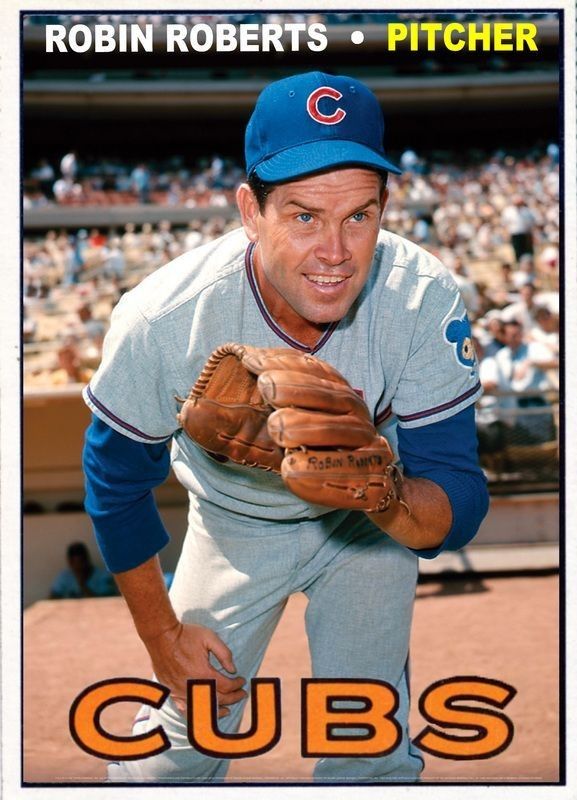
Robin Roberts 286th and Final Win: Chicago Cubs at Atlanta Braves, August 29, 1966


The story of Robin Roberts 286th and last major league victory is one for the ages. It is the story of one great pitcher passing the baton to another and the story of two old friends in the twilight of their careers patching together one more winning effort.

By August of 1966, Hall of Fame pitcher, Robin Roberts was just about at the end of the road. At 39 years-old, and with his once blazing fastball a distant memory, Roberts had been released by the Houston Astros on July 4 and hooked on with the Cubs as a player/coach for manager Leo Durocher's last place team. As a pitcher, Roberts was having indifferent success as a starting pitcher. As a coach, he became an advocate for a young pitcher who had just come over to the Cubs from the Phillies, Ferguson Jenkins. 

Durocher had been using Jenkins almost exclusively in relief. Roberts felt Jenkins got hit around sometimes because he did not have confidence in his stuff. He encouraged Jenkins to throw his fastball more and he encouraged Durocher to try Jenkins as a starter. In late August, Jenkins joined the rotation as a starter, replacing the fading Roberts. On August 29, Jenkins was the starting pitcher against Tony Cloninger and the Atlanta Braves at Atlanta Stadium. 

The Braves opened the scoring for the game in the second inning on a Gary Geiger solo home run. The game remained a 1-0 affair until the Cubs finally broke through with a run in the sixth on consecutive singles by Ron Santo, Ernie Banks, and John Boccabella. The Cubs took the lead in the seventh on a Don Kessinger sacrifice fly and the game went into the bottom of the ninth with Jenkins and the Cubs holding onto that one run lead.

In the ninth, Eddie Mathews led off with a double to center and Lee Bales ran for him. After Henry Aaron flied out, Joe Torre singled to left, with Bales stopping at third. At this point Durocher replaced Jenkins with Len Church. Rico Carty hit a sacrifice fly to centerfield and the game was tied and headed for extra innings. Church got the Braves out in the 10th and pitched into the 11th, but when Torre opened the inning with a walk, and Carty followed with a single, Durocher called on another former Phillie from the bullpen, none other than lefty Curt Simmons. Simmons, who had been Roberts longtime teammate, was also nearing the end of his fine career, spent mostly with the Phillies and St. Louis Cardinals. 

Simmons got Geiger to bounce to third, where Santo touched the bag to force Torre. That was it for Simmons day of work, as Cal Koonce was called on to replace him. Koonce escaped the inning and the game rolled on into the 13th still tied at 2-2.

In the top of the thirteenth, Lee Thomas batted for Koonce and after Billy Williams popped out with the bases loaded to end the inning, Roberts came out of the bullpen to begin the bottom of the thirteenth. Robbie allowed two singles in the inning, but escaped by getting Felipe Alou to ground into a force-out, shortstop Don Kessinger to second baseman Glenn Beckert. 

The Cubs rallied for two runs in the top of the 14th on a single by Banks, a double by Adolfo Phillips, and a pinch-hit RBI single by George Altman. Durocher allowed Roberts to bat for himself (he flew out to left) and so Roberts went to the mound with a chance to close down the victory, He did so by striking out Mike de la Hoz, getting Aaron to fly out to center, and after walking Torre, inducing Carty to fly out to right.

Thus ended Robin Roberts 286th and final major league victory. He would appear in one more game for the Cubs in September and close out his major league career. It seems just that the game included an excellent starting pitching performance by Ferguson Jenkins, who would go on to have a Robin Roberts like career, winning 20 or more games in six consecutive seasons for the Cubs and concluding his Hall of Fame career with 284 career victories, falling short of his mentor by two wins. 

It also seems just that Roberts old friend (and next door neighbor in suburban Philadelphia), Curt Simmons, pitched in the game. Simmons would end his fine career the following year with a total of 193 victories. So, this Cubs game that saw three former Phillies pitch also saw three pitchers who racked up a combined total of 763 victories by the end of their careers. Some truly great pitching talent appeared on the mound for the Cubs on that day.


Sunday, January 24, 2021

Henry Aaron: Phillie Killer


Henry Aaron was probably the single most famous person I ever got to meet personally. In 1978 or 79, about a year or so after he had retired from baseball as the all time home run champion, Aaron appeared at a luncheon at the old Alvino's Restaurant in Langhorne, PA. As the coach of the Bristol High School baseball team, I was invited to bring some of my players and attend the luncheon. There we got to shake hands with the great man and pose for a group picture with him. I don't now remember the topic of Aaron's talk, but I remember how he spoke: quietly and with dignity, just the way carried himself as a ballplayer for so many years. 

Many people may remember Aaron as the prolific home run hitter that he was. The image of the aging star turning on an Al Downing fastball and launching it over the fence for home run 715, breaking Babe Ruth's record is burned in most of our minds. For me, however, who was lucky enough to have seen Aaron play in the late 1950s and early 1960s, Aaron was the consummate line drive hitter, slashing base hits to every part of the ballpark and often hustling them into doubles and triples. Many of those line drives also left the park, of course, but they were almost always line drives, not those long majestic bombs hit by other sluggers of the day like Harmon Killebrew or Mickey Mantle. 

Perhaps that is why Aaron suddenly sneaking up on Ruth's record came as a surprise to many. He never had huge home run numbers; the most he ever hit was 47. What Aaron was was a consistent hitter. Probably the most consistent power hitter in baseball history. While he never hit 50 homeruns in a season, he hit 30 or more in 15 of his 23 seasons and exactly 44 homeruns (the number he wore on his back) four times.

As a lifelong Phillies fan, what I mostly remember about Aaron is how often he seemed to beat the home team. For his career. Aaron hit .318 against the Phillies pitchers with 76 home runs. Connie Mack Stadium was one of his favorite away ballparks. He hit 39 home runs there, topped only by Chicago's Wrigley Field (50) and Cincinnati's Crosley Field (43). Remarkably, Aaron hit 16 triples in old Connie Mack, seven more than he hit at any other away ballpark. This reinforces the view of Aaron as a line drive hitter with speed. Connie Mack had a spacious outfield that gave the advantage to a guy who hit the ball on a line in the gaps.

Aaron had some special games at Connie Mack Stadium like the night of June 14, 1957 when he went 3 for 5 with a homerun and 4 RBIs in a 10-5 Braves win. Or the night of May 22, 1959 when he had four hits including a two-run home run off Robin Roberts,  scored 4 runs and knocked in 3 more. And then there was the May 30, 1961 game when Aaron's eighth-inning triple drove in the 2 runs that were the difference in a Braves 3-1 victory. In a 5 game series against the Phillies in July of 1962 Aaron compiled 9 hits, 2 home runs, and 6 runs scored. In a three game series in 1968 he collected 8 hits, including 2 home runs. Aaron had a 2 home run game at Connie Mack on April 20, 1966. The second home run that day, off Bo Belinsky, was the 400th of Aaron's career. Two years later, on July 26, 1968, he would hit career number 501 at Connie Mack off Grant Jackson.

Aaron's greatest day at Connie Mack Stadium came on Thursday night, May 3, 1962. It started with a solo home run against Art Mahaffey in the first. Aaron led off the 3rd with one of his patented Connie Mack Stadium triples and then scored on a Joe Adcock sacrifice fly. Aaron doubled in the fifth, before striking out in the 7th. He finished off the evening with a two-run home run in the 9th off Phils reliever Jack Baldschun, to tie the score at 8-8. The Phillies finally won the game in the bottom of the ninth when Clay Dalrymple singled home Johnny Callison. Aaron's line for the night: 5 AB, 3 R, 4 H, 3 RBIs, 2B. 3B, 2 HRs.

To be fair to the Phillies though, virtually every team that Aaron played against in his prime could point to similar numbers. He batted .326 for his career against the Cubs and swatted 97 home runs against the Reds. Henry Aaron was simply a great hitter. I was lucky enough to see Mays and Aaron close up in their primes. Mays was certainly the more charismatic player on the field, but as one wag once said, "Aaron could do everything Mays could do, but his cap stayed on."


Wednesday, January 13, 2021

Robin Roberts Amazing 17 Inning 300 Pitch Performance


 In 1952, Robin Roberts was unquestionably the best pitcher in baseball. He won 28 games and lost only 7. He won 20 of his final 22 starts and 17 of his final 18. He completed 30 of the 37 games he started and threw 330 innings, the most in the league in 25 years. Over those 330 innings he walked only 45 batters. All of these were remarkable accomplishments, of course, but in a September game against the Boston Braves when he wasn't at his best, he may have turned in his most remarkable single performance.

Robbie was looking for his 23rd victory of the year when he took the mound on Saturday afternoon September 6 in the first game of a double header. He did not have his best stuff.  The Braves scratched out two runs in the fourth inning and then scored another three in the sixth inning on three hits and a pair of Phillies errors. The Braves 6th run of the day came on an Eddie Matthews home run in the eighth inning. The Phillies rallied, however, and tied the score with four runs in the bottom of the eighth on five hits; the big blow being a two run, two RBI Jackie Mayo double.

Roberts shut down the Braves in the ninth with the help of the Phillies defense catching Johnny Logan trying to score from first on a single by Earl Torgeson. The Phillies went down quietly in the ninth and Roberts walked out to the mound as the game went into extra innings. The Braves managed to get runners on in each of the next 8 innings except for the 17th. Each time, Roberts wriggled out of trouble. In the 12th inning, Boston opened with back-to-back singles by Sid Gordon and Earl Torgeson. Roberts then fielded Matthews bunt and threw out Gordon at third. He then induced a double play grounder from pinch-hitter Walker Cooper. In the 15th Jack Daniels led off with a double and moved to third on Jack Ditmer's long fly ball. Roberts worked out of it by striking out pitcher Bob Chipman and getting Sam Jethroe to ground out to first. 

Meanwhile, the Phillies were flailing futilely at the offerings of left-handed reliever Chipman. They managed only a couple of singles from the 10th through the 16th. Finally, in the bottom of the 17th inning, Phillies slugger Del Ennis came to the plate and belted a line drive over the fence in left. Pandemonium broke out in the ballpark. Final score: Phillies 7 Braves 6. A weary Roberts had his 23rd win of the season.

A look inside the numbers shows just how remarkable this performance was. His 17-inning complete game was the longest complete game victory by any pitcher since Dizzy Dean pitched a 17-inning win in 1934 and there has not been a pitching performance to match it since. Vernon Law of the Pirates did pitch 18 innings in a game he started in 1955, but he was pulled from the game before it ended in a Pirate victory in the 19th. Roberts not only pitched a 17-inning complete game, but he was pitching his way out of trouble the whole way. He was touched for a total of 18 hits; he walked 3 and struck out 5. In all he faced an astounding 71 batters. Major league baseball did not keep track of  pitch counts in those days, but a rough estimate of an average of 4 pitches per batter would mean that Roberts threw close to 300 pitches for the game. Robbie was a workhorse though. He made his next start four days later on regular rest, a 3-2 complete game victory. It was like his teammate Curt Simmons said of him, "He was like a diesel engine. The more you used him, the better he ran. I don't think you could wear him out."*


*The National Baseball Hall of Fame Almanac, Durham: Baseball America, 2017 Edition), 370.


Tuesday, December 29, 2020

Rollins' Rousing Triple: September 30, 2007


I have had the good fortune to see many great games and many great plays in person over my 70+ years of being a baseball fan. I have seen games to clinch the World Series and games to clinch pennants. I have seen Dick Allen hit a home run over the roof at Connie Mack Stadium and Roy Halladay throw a playoff no-hitter. But one play, more than any other, stands out as the most exciting play I have ever witnessed in person. That play was Jimmy Rollins' thrilling triple on the final day of the 2007 season.

First some context. The Phillies of 2007 were a fast improving team with stars Ryan Howard, Chase Utley, and Rollins, and a blossoming ace pitcher in Cole Hamels, but they had  yet to come together as a pennant contender. The previous year, the New York Mets had run away with the division, finishing 12 games ahead of the second place Phils. Nonetheless, in February of 2007, Rollins boldly, many would say foolishly, declared the Phillies the favorite in the National League East. "Bottom line, we're the team to beat," said Rollins, "I can't put it any other way."

Despite Rollins best efforts, and they were indeed great efforts in this Rollins' MVP year, the Phillies found themselves 7 full games behind the Mets on September 12.  The Phillies then went on a furious run, winning nine of ten to find themselves in a dead heat with New York on the final day of the season. If both teams won or both teams lost a playoff loomed. If the Phils lost and the Mets won the  Phillies season was over. If the Phils won and the Mets lost, the Phillies were in the playoffs for the first time in 14 long and mostly lean years.

As my friend and fellow Phillies fanatic, Don, and I worked our way to our usual Sunday afternoon seats down the first base line in Citizens Bank Park, excitement was building. The Mets game in New York started about twenty minutes before the Phillies game. As we sat down, the right field scoreboard flashed the score in New York. The lowly Marlins had put up 7 runs against Tom Glavine and the Mets in the first inning. This was the best possible scenario imaginable. The Mets looked headed for defeat even before Jamie Moyer took the mound for the Phils against the Washington Nationals. 

From there the day played out like one long celebration. The Phillies took the lead in the bottom of the first when Rollins singled, stole second and third, and scored on an Utley sacrifice fly. In the third a Carlos Ruiz double, a Rollins walk, and a Ryan Howard single plated two more runs. In the fourth inning a Gregg Dobbs error at third lead to an unearned run and the game stood at 3-1 Phils. Meanwhile the Mets were getting no closer to the Marlins in New York, where the score stood at 8-1 moving to the seventh.

In the bottom of the sixth, Pat Burrell walked to lead off the inning and the speedy Michael Bourne ran for him. Chris Coste, who had replaced Ruiz as catcher after Carlos was hit by a pitch earlier, was then also hit by a pitch. With runners at first and second, Abraham Nunez (in as a defensive replacement for Dobbs at third base) put down a sacrifice bunt to move the runners to second and third. Tadahito Iguchi then batted for reliever Tom Gordon and launched a sacrifice fly to deep right center that scored Bourne from third and moved Coste up to third. With a man on third and two outs, Jimmy Rollins strode to the plate. 

Rollins, the prognosticator of Phillie success from February, was having a career year. His offensive numbers were off the charts. As he climbed into the batters box he had amassed 38 doubles, 30 home runs, 41 stolen bases, and 19 triples. One more triple would make Rollins a member of one of baseball's most exclusive clubs: the 20-20-20-20 club. Only Frank Schulte (1911) Willie Mays (1957) and Curtis Granderson (also 2007) were members. Statistically aware fans were hoping against hope that Rollins would get a triple on this day to round out a near perfect year for the little shortstop. More important was getting some kind of hit to get the fifth run across the plate.

Rollins, batting left handed against Nationals righty, Luis Ayala, worked the count to 3-2, fouling away a couple of pitches. He then laced a ringing line drive down the right field line for a hit, Coste scored easily, and Jimmy was off and running in his familiar arms-pumping, legs churning style. The hit was a sure double, but everyone could see that Rollins was thinking triple out of the box. As he rounded second and took off for third, I pounded Don on the back and shouted, "He's going to go for it."  The outcome was far from a foregone conclusion. The ball clattered against the fence and hopped over the head of Nationals right-fielder. Austin Kearns who chased it down and threw to the cut off man, second baseman Ronnie Belliard who wheeled and launched a strong throw to third. As Rollins dived for the bag, third baseman Ryan Zimmerman caught the ball on one hop and slapped down the tag a whisper too late. Umpire Bruce Dreckman emphatically signaled safe and the crowd went bonkers. Don and I slapped high fives with everyone within our reach.

A few innings later, the Mets had lost, Brett Myers had struck out Willie Mo Pena for the final out of a 6-1 victory and the Phillies were on the way to the playoffs.

Knowledgeable baseball people have long said that the triple is the most exciting play in baseball. On this day, for this fan, watching this marvelous player, this triple was indeed the most exciting play I ever saw. It was the perfect exclamation point on an extraordinary season for a team and its inspirational leader.


Friday, December 4, 2020

Curt Simmons Spectacular Debut: September 28, 1947


The death of pitcher Bob Miller last week, means that only one member of the 1950 Whiz Kids survives, lefty hurler, Curt Simmons. Simmons was a key member of the 1950 pitching staff, going 17-8 during that pennant winning season. Unfortunately late in the year, he was called up to active duty in the army and was not available to pitch in the World Series. Simmons was a hometown boy, of sorts, having grown up in Egypt, PA, near Allentown, about 70 miles from Philadelphia's Shibe Park. Although he was only 21 years-old in 1950, Simmons was already a veteran of the Phils staff, having been a regular part of the rotation since 1948. Simmons made his debut with the Phillies on a memorable September Sunday in 1947 at the age of 18, only months out of high school, in a game that kept Phillies fans talking about Simmons potential throughout the long winter.

Simmons debut was eagerly anticipated. He had been the most sought after pitcher in the country after showing off his blazing fastball in high school and American Legion competition. In 1945 he had been named "All-American Boy" in Philadelphia after pitching in a Legion All-Star game there. Ty Cobb and Babe Ruth, who managed those teams, called him the greatest young ball player they had ever seen. After signing with the Phillies, he was assigned to their affiliate in Wilmington, DE where he took a seventh place team and pitched them into the playoffs with a 13-5 record, and then won two games in leading them to the league championship. The next day, Simmons was called up to the big club.

A crowd of more than 14,000 showed up on Sunday, September 28, 1947 to see a meaningless double-header on the last day of the season between the seventh placed Phillies and the fourth placed New York Giants. The fans were there to see Simmons, who was scheduled to pitch the second game. Thrust on to the big stage at a very tender age, Curt did not disappoint, dominating the Giants from start to finish, pitching a complete game, and leading the Phils to a 3-1 victory.

Philadelphia Inquirer reporter, Stan Baumgartner enthused that Simmons used "a fastball that was so alive it occasionally squirted out of catcher Andy Seminick's glove and a curve that broke like a jug handle" to keep the slugging Giants at bay. The Giants featured the major league leading home run hitter Johnny Mize, who clubbed 51 that year, as well as Bobby Thompson (28) and Willard Marshall (36). None could manage more than a weak single off Simmons, who gave up just five hits (4 singles and a double) and struck out nine. The only blemish on the pitching record for the day came in the ninth inning, when with two outs,  two walks and a Buddy Blattner pinch-hit single ruined the shut out. Simmons then finished up in style by retiring the heavy-hitting Mize on a routine ground ball to second base. 

When it was all over thousands of youngsters streamed out of the stands like it was the seventh game of the World Series surrounding Simmons and. according to Baumgartner, "practically pushed him along the grandstand to the clubhouse." For his part, young Simmons was modest and composed in speaking about the victory. "I was a bit nervous, always am, before a game. After it started I just told myself it was just like Wilmington - just another game. And that is really all it was. Andy Seminick did a great job behind the bat for me. He seemed to know just what to call and three times when I broke the curve ball in front of the plate with men on he made great pick ups. The boys fielded well behind me, too. Just tell all my friends in Egypt and all the Phil fans that I am very happy I got such a fine start." 

Great talent, great poise, and the ability to talk to the media. Eighteen year-old Curt Simmons was a rising star indeed.

If Simmons did not quite fulfill all of the promise he demonstrated on that distant Sunday afternoon, he certainly became a very fine major league pitcher for a very long time. Over a twenty year career, often interrupted by military service and injury, Simmons compiled 193 wins. and eventually did get to pitch in the World Series at the age of 35 with the 1964 World Champion St. Louis Cardinals.