Tuesday, April 6, 2021

Granny Hamner's 7 RBI Day: July 17, 1948

In 1969, one year before Larry Bowa took over as the starting shortstop for the Phillies and 32 years before Jimmy Rollins began his tenure at short, Granville Wilbur Hamner was voted the greatest Phillies shortstop of the teams' 100 year history. And while both Bowa and Rollins would eventually surpass Hamner as all-time greats at the position, Hamner did manage one feat that neither Bowa nor Rollins ever achieved. On July 17, 1948, Hamner drove in seven runs in an 11-10 Phillies win over the St. Louis Cardinals at Sportman's Park. Ironically for the man who ranks third all-time in games at shortstop for the Phillies, Hamner was actually playing second base on this day as he did for most of the 1948 season, before establishing himself as a the star shortstop and fiery leader of the Whiz Kids.

Hamner had been up briefly with the Phils from the time he was a 17 year-old in 1944. After getting more experience in the minors and after a stint in military service in World War II, Hamner finally established himself as a regular as a 21 year-old in 1948. The Phillies, however, had traded with the Cincinnati Reds for veteran shortstop Eddie Miller during the off season, so Hamner was slotted in at second base. He was never comfortable there, feeling he was too slow at turning the double play. His solid, clutch hitting, however, kept him in the lineup.

On a warm, muggy Saturday afternoon in St. Louis the young Hamner played the hero for the Phillies. The Phils got off to a fast start in the top  of the first, when after two were out, Cardinal pitcher Al Brazle walked Johnny Blatnick and Del Ennis. Dick Sisler followed with a double to score Blatnick and move Ennis to third. Eddie Miller was then intentionally walked and Hamner, batting seventh in the lineup, made the Cardinals pay for that strategy by sizzling a line single to center to score two runs. In the second inning, now facing pitcher Ken Burkhart, the Phillies piled on more runs. Richie Ashburn led off with his second walk of the game. After Bert Haas popped out, Blatnick singled and Ennis drove home Ashburn with a double. Sisler was walked intentionally and Miller struck out, leaving the bases loaded and two out for Hamner. Granny drove a Burkhart pitch into left center, clearing the bases with a long double.

Hamner now had five RBIs in two innings, but he was not finished yet. Phillies starting pitcher Blix Donnelly managed to give most of the 7-1 lead back in the bottom of the second inning, an inning that included a Stan Musial grand slam home run. By the time the smoke cleared, the score was 7-6 and Donnelly had been replaced by lefty Ken Heintzelman. Heintzelman could not hold the lead. He gave up a tying solo home run to Nippy Jones in the third, and the Cardinals took an 8-7 lead in the fourth on a couple of walks, a wild pitch, and a ground out.

The Phillies roared back in the sixth inning, however. Haas and Blatnick opened with singles and scored on another Ennis double. Sisler walked, Miller popped out and Hamner came to the plate with runners on again. This time he smacked a  double to right field, scoring both Ennis and Sisler and giving the Phillies an 11-8 cushion. As it turned out they would need everyone of those runs. In the seventh the Cardinals made it close scoring two runs on singles by Erv Dusak and Ralph LaPointe and a  Bill Baker double. 

Phil reliever Monk Dubiel quieted the Cards in the eighth and ninth with the help of two double plays, both started by, you guessed it, Granny Hamner. As the Philadelphia Inquirer's Stan Baumgartner described the plays, in the eighth Hamner made a "magnificent one hand pick-up of Nippy Jones hard rap, stepped on second and then relayed the ball to first." In the ninth Hamner "scooped pinch-hitter Terry Moore's rap over the keystone, tossed to Eddie Miller who relayed to Dick Sisler for the twin killing." Baumgartner concluded it was "[Hamner's] greatest day in the big leagues."

Hamner's box score line for the day: 5 ABs, 3 H, 2 2b, 7 RBI, 8 assists, 3 put outs, and 3 double plays started.

Granny Hamner would go on to have many more fine days in the big leagues and would be named the captain of the Whiz Kids team that won the pennant in 1950. Each year from 1949 to 1954 he played in 150+ games for the Phillies and was named to the National League All Star team three times. Knee and shoulder injuries slowed Hamner in his final few years and he ended his career as a knuckleball pitcher, of all things, for the 1962 Kansas City Athletics. After his career was over, Phillies owner Bob Carpenter would remember Hamner as the "best clutch hitter we ever had." 


Tuesday, March 30, 2021

An Unlikely Opening Day Hero: Ken Heintzelman, Phillies 1949

On April 1st this year Aaron Nola is scheduled to take the mound for the fourth time as the Philadelphia Phillies opening day starter. Nola will join famed Phillies pitchers like Steve Carlton (14), Robin Roberts (12), Chris Short (6), Curt Schilling (5), and Grover Cleveland Alexander (5) as Phillies pitchers who have started four or more opening day games. On the list of opening day starters who started just one opening day game are such lesser lights as the wonderfully named Johnny Lush (1906), as well as Flint Rhem (1933), and Omar Daal (2001). Another of these one time opening day starters was an unlikely choice indeed, the journeyman left-hander, 33 year-old Ken Heintzelman, who was manager Eddie Sawyer's pick to open the season in 1949 against the defending National League champion Boston Braves.

Heintzelman came to the Phillies in 1947 after having spent eight seasons with the Pittsburgh Pirates. During his time with the Pirates, Heintzelman recorded a less than sterling 37-43 won-loss record and 4.17 ERA. In the 35 starts he had for the Phillies in 1947 and 48 things did not get any better, as he went 13-21  with a 4.20 ERA. Heintzelman, however, had an excellent spring training in 1949, allowing only three runs in 26 2/3 innings, so Sawyer, who had an otherwise young starting pitching staff featuring Robin Roberts, Curt Simmons, and Russ "Mad Monk" Meyer, decided to go with his veteran lefty. Opposing Heintzelman would be the ace of the Braves staff, Johnny Sain. Sain had won at least 20 games in each of the past three seasons and had teamed with Warren Spahn as the duo made famous as "Spahn and Sain and pray for rain" who had led Boston to the pennant in 1948.

Heintzelman responded to the only opening day assignment of his career by pitching one of his finest games ever. He hurled a complete game, five-hit shut out and the Phillies scratched out four runs off the surprisingly shaky Sain for a 4-0 victory. Heintzelman walked three and, amazingly, did not strike out a batter, relying on getting the Braves to hit the ball on the ground. The Phillies infielders recorded 14 assists on the day.

The game was played at Braves Field in Boston in front of what Philadelphia Inquirer reporter, Stan Baumgartner, said was a "frost-bitten crowd of 9,195." The Phillies got off to a fast start in the top of the first, when lead-off batter Richie Ashburn singled and then beat Sain's ill-advised throw to second on Granny Hamner's sacrifice bunt. Eddie Waitkus also bunted and again Sain tried to nab Ashburn, this time with a throw to third base. Again Ashburn beat the throw and the bases were loaded. After Ennis lined out on a spectacular leaping grab by Braves shortstop Alvin Dark, Bill Nicholson walked, forcing in Ashburn with the game's first run. Willie Jones popped out to second, but Sain then walked  Eddie Miller, forcing in Hamner and Heintzelman had a 2-0 lead before he threw a pitch.

The Phillies extended their lead in the third, again thanks to some shaky defense by Sain. Ennis opened the frame with a single and then Nicholson bunted. Sain fielded the bunt, but threw wildly to first, allowing Ennis to advance to third, where he scored as Willie Jones bounced into a double play. Meanwhile, Heintzelman was mowing the Braves down with the help of his infield defense. In the second, fifth, and sixth innings, the Braves got their leadoff man on, only to have the runner wiped out by a double play. That double play in the fifth was particularly important as the Braves followed that twin killing with singles by Phil Masi and Sain, but were unable to score.

Heintzelman retired the Braves in order in the seventh and eighth and the Phillies padded their lead in the ninth. Stan Lopata opened the frame with a single, and Heintzelman aided his own cause by laying down a sacrifice bunt moving Lopata to second. Ashburn grounded out to second, moving Lopata to third. Hamner then lashed a double to left-center scoring Lopata with the fourth and final Phillies run.

Dark opened the Braves ninth with a double, the only extra base hit Heintzelman allowed on the day, but the next three batters popped out and the Phillies had an opening day victory and Heintzelman had his shut out.

The game proved to be a harbinger for the 1949 season. Ken Heintzelman had his finest season in a thirteen year major league career, going 17-10, with an excellent 3.02 ERA. He led the Phillies that season with a 6.1 WAR. He also led the league with five shutouts. From July 5 to July 23 he twirled 32.2 consecutive shut out innings, a run that included consecutive 1-0 victories over the St. Louis Cardinals and Chicago Cubs.  The St. Louis game was won in dramatic style when Del Ennis hit a walk-off home run in the bottom of the ninth off the Cards' Hal Lanier. In the meantime, Johnny Sain had the worst year of his career, falling to 10-17 (the exact reverse of Heintzelman's record) with a high 4.81 ERA.

Unfortunately, Heintzelman could not repeat his 1949 performance during the Phllies pennant winning season of 1950. That year his record was 3-9 with a 4.09 ERA and he lost his place in the starting rotation. During the World Series against the Yankees, however, with his pitching staff decimated by military call-ups and injury, Eddie Sawyer called on the old pro to start game three. The Phillies were already down 2-0 in the series when Heintzelman took the mound. He pitched very well, giving up just one run through the first seven innings. In the eighth he recorded two outs and then walked three consecutive batters. He was replaced by Jim Konstanty and a Hamner error allowed in the tying run in a game the Phillies eventually lost 3-2.

After two more indifferent seasons with the Phillies and three seasons in the minor leagues, Heintzelman retired at 39 with a career major league mark of  77-98. His son, Tom Heintzelman played four seasons as a utility infielder for the Cardinals and San Francisco Giants.


Tuesday, March 23, 2021

How Tadahito Iguchi Saved the Phillies 2007 Division Championship

Second Baseman Tadahito (Tad) Iguchi was the first ever Japanese player to don a Phillies uniform. He did so on July 28, 2007. He came to the Phillies in an emergency trade with the Chicago White Sox made necessary because All Star second baseman and soul of the team, Chase Utley, had been hit by a pitch that broke his right ring finger. The injury would require surgery and Utley would be out for an undetermined period of time. At the time, the Phillies were in second place tied with Atlanta four games behind the New York Mets.

Everyone recognized that Utley was impossible to replace, but management thought the 32 year-old, soon-to-be free agent Iguchi was the best player available. He did not disappoint. Iguchi reached base by hit or walk in the first 14 games he played for the Phillies. He had 21 hits in those 14 games for a .362 average. On July 30th, he had two hits, including a home run in a 4-1 win over the Cubs. On August 5th, he contributed three hits and scored two runs in a 5-3 win over the Milwaukee Brewers. 

When Utley returned to the lineup on August 27th, Iguchi was relegated to the bench for the first time in his professional career (eight years in Japan and three in the US). That night, in his first appearance as a pinch hitter for the Phillies, he launched a two run home run in a vital 9-2 win over the division leading Mets. Three days later, on August 30th, Iguchi scored the winning run in the Phillies thrilling 11-10 come from behind win that completed a four game sweep of the Mets and propelled the Phils to the division championship one month later. In that game, Iguchi had a pinch hit RBI single in the ninth to tie the game. He then stole second base and scored the winning run when none other than Chase Utley singled him home.

Throughout September, Iguchi served as a key pinch hitter and occasional replacement for Utley at second base. On the last day of the season, with the Phillies needing a win to take the division championship from the Mets, Iguchi had a sixth inning pinch hit sacrifice fly that lengthened the Phillies lead to 5-1 in a game they eventually won by a score of 6-1, garnering their first division championship in 14 years. It is hard to see how they could have done this without Iguchi's contributions. In his 45 games with the Phils, he slashed .304/.361/.442 and played flawlessly in the field, recording a 1.000 fielding percentage and turning 30 double plays. 

Iguchi appeared three times as a pinch hitter in the Division Series, walking twice, as the Phillies bowed out of the playoffs with three straight losses to the Colorado Rockies. A free agent, he signed a one year deal with the San Diego Padres, where he had an off year in 2008 and was released on September 1. The Phillies picked him up for the stretch drive and he appeared in four games for the Phillies in that Championship year. Iguchi was not eligible for post season play because he was signed after September 1, but he received a much deserved World Series ring anyway.

In 2009, Iguchi returned to Japan, where he played 9 more seasons with the Chiba Lotte Marines. Retiring at 42 years of age, he is now the manager of the Chiba Lotte team.


Tuesday, March 16, 2021

The Legend of Robert Dodd


Robert Dodd was a left-handed relief pitcher who appeared for the Phillies in four games in 1998. Dodd achieves legendary status, not only because he finished his major league career with a 1.000 winning percentage (1-0), but also for the unlikely way he did it. In the Philadelphia Phillies 137 year history, 47 pitchers have achieved a perfect 1.000 winning percentage. Included in that number are notable non-pitchers like Hall Of Fame slugger, Jimmie Foxx and utility infielder extraodinaire, Wilson Valdez. None of them earned a less likely victory than did Robert Dodd.

Dodd was drafted by the Phillies in the 14th round out of the University of Florida, and worked his way steadily through the minor league system including stops in Batavia, Clearwater, Reading, and Scranton/Wilkes-Barre. Beginning his career as a starter, by the time he reached Reading Dodd was a lefty specialist, usually appearing for one inning or less. Also while at Reading, Dodd suffered from debilitating back pain that required disc surgery. 

After the surgery his normal 6'2" inch height had grown to 6'3". Dodd's surgery gave him new found life on his pitches and he was assigned to the Phillies top farm club at Scranton/Wilkes-Barre to begin the 1998 season.

On May 24, the Phillies placed left-handed reliever Yorkis Perez on the disabled list and recalled Dodd. Dodd made his first major league appearance on May 28 against the Chicago Cubs in Wrigley Field. He relieved Curt Schilling in the sixth inning with the Phils down 7-1 and pitched to a no-decision in one shut out inning. The Phillies eventually came back to win the game 8-7. In his next two games, Dodd was hit around a bit in games the Phillies lost by scores of 11-0 and 14-8.

By the time Dodd was called in to mop up in the ninth inning of a June 16th game at Veteran's Stadium against the Pittsburgh Pirates, he was burdened with a 9.00 ERA. When he entered the game, the Phillies were down 7-1. The Pirates had scored early and often off of Phils starter Tyler Greene, while the Phillies had managed just the lone run on a Gregg Jefferies sixth-inning home run off the Pirates' Esteban Loaiza. The game was interrupted by a lengthy rain delay in the sixth inning, which managed to send most of the 24,000+ who attended scurrying for the exits. Dodd worked around a lead-off single by Jason Kendall and escaped the ninth inning unscathed. He then sat down in the dugout and watched as an improbable Phillies rally gave him his first and only major league win.

In the bottom of the ninth, Phillies second baseman Mark Lewis greeted Pirates reliever Ricardo Rincon with a single to right. Bobby Abreu followed with a triple to score Lewis. Catcher Mark Parent and shortstop Desi Relaford both walked. That was all for Rincon and Pirates' manager Gene Lamont called on Rich Loiselle from the bullpen. Third baseman Alex Arias then smacked a double play ground ball that shortstop Lou Collier kicked into centerfield. Abreu and Parent scored, while Relaford moved to third and Arias held on at first. The game now stood at 7-4 with the tying run coming to the plate. 

The crowd, aroused by the sudden rally, got louder. "I don't know if it was their alcohol consumption or what," said Relaford, "but they were behind us and we had nothing to lose.”

Doug Glanville lofted a sacrifice fly to right field scoring Relaford. Kevin Sefcik hit a double play ground ball to Tony Womack at second, but Womack tagged Arias who bumped Womack just enough so that Sefcik was able to beat the throw to first by a whisker. At this point, Scott Rolen's place in the order came up, but Rolen had been tossed from the game in the fourth inning, along with manager Terry Francona, for arguing balls and strikes with ump Greg Gibson. So, up to the plate came Rolen's replacement Kevin Jordan. Jordan walked. With the score 7-5 and two men on base, Mike Lieberthal came to the plate to pinch hit for Dodd. Lieberthal worked the count to 2-2 and then launched  a line drive shot over the wall in left field for an improbable walk-off win.

Robert Dodd had his first, and only, major league win. In the video below, he can be seen briefly celebrating the win with his teammates. When he got back to the Phillies clubhouse, Dodd was told that he was being sent back to Scranton/Wilkes-Barre. Manager Terry Francona apologized to him for the bad timing, but the decision had been made before the game was played. Dodd never made it back to the big leagues. After a few more years in the Phillies system, Dodd pitched three years for the Somerset Patriots of the independent Atlantic League, before hanging his spikes up for good in 2003 at the age of 30.


H/T @TheReliefRoom for bringing this story to my attention.


Wednesday, February 24, 2021

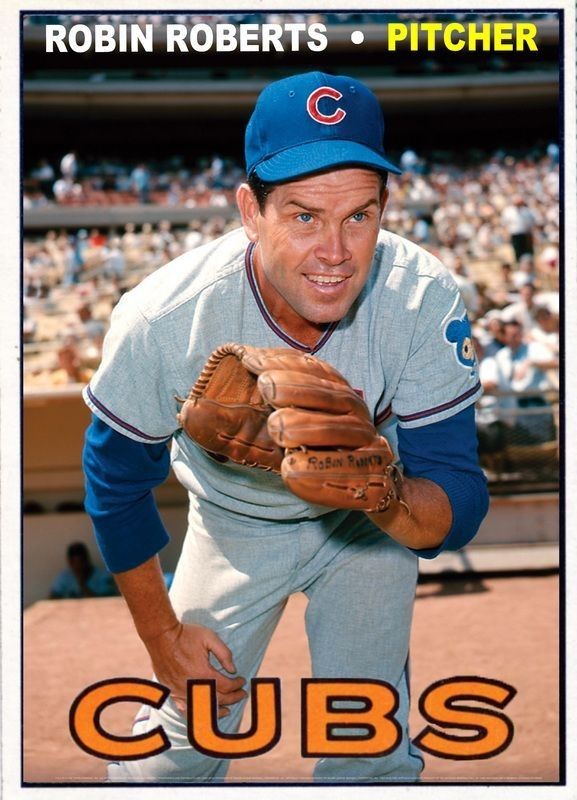
Robin Roberts 286th and Final Win: Chicago Cubs at Atlanta Braves, August 29, 1966


The story of Robin Roberts 286th and last major league victory is one for the ages. It is the story of one great pitcher passing the baton to another and the story of two old friends in the twilight of their careers patching together one more winning effort.

By August of 1966, Hall of Fame pitcher, Robin Roberts was just about at the end of the road. At 39 years-old, and with his once blazing fastball a distant memory, Roberts had been released by the Houston Astros on July 4 and hooked on with the Cubs as a player/coach for manager Leo Durocher's last place team. As a pitcher, Roberts was having indifferent success as a starting pitcher. As a coach, he became an advocate for a young pitcher who had just come over to the Cubs from the Phillies, Ferguson Jenkins. 

Durocher had been using Jenkins almost exclusively in relief. Roberts felt Jenkins got hit around sometimes because he did not have confidence in his stuff. He encouraged Jenkins to throw his fastball more and he encouraged Durocher to try Jenkins as a starter. In late August, Jenkins joined the rotation as a starter, replacing the fading Roberts. On August 29, Jenkins was the starting pitcher against Tony Cloninger and the Atlanta Braves at Atlanta Stadium. 

The Braves opened the scoring for the game in the second inning on a Gary Geiger solo home run. The game remained a 1-0 affair until the Cubs finally broke through with a run in the sixth on consecutive singles by Ron Santo, Ernie Banks, and John Boccabella. The Cubs took the lead in the seventh on a Don Kessinger sacrifice fly and the game went into the bottom of the ninth with Jenkins and the Cubs holding onto that one run lead.

In the ninth, Eddie Mathews led off with a double to center and Lee Bales ran for him. After Henry Aaron flied out, Joe Torre singled to left, with Bales stopping at third. At this point Durocher replaced Jenkins with Len Church. Rico Carty hit a sacrifice fly to centerfield and the game was tied and headed for extra innings. Church got the Braves out in the 10th and pitched into the 11th, but when Torre opened the inning with a walk, and Carty followed with a single, Durocher called on another former Phillie from the bullpen, none other than lefty Curt Simmons. Simmons, who had been Roberts longtime teammate, was also nearing the end of his fine career, spent mostly with the Phillies and St. Louis Cardinals. 

Simmons got Geiger to bounce to third, where Santo touched the bag to force Torre. That was it for Simmons day of work, as Cal Koonce was called on to replace him. Koonce escaped the inning and the game rolled on into the 13th still tied at 2-2.

In the top of the thirteenth, Lee Thomas batted for Koonce and after Billy Williams popped out with the bases loaded to end the inning, Roberts came out of the bullpen to begin the bottom of the thirteenth. Robbie allowed two singles in the inning, but escaped by getting Felipe Alou to ground into a force-out, shortstop Don Kessinger to second baseman Glenn Beckert. 

The Cubs rallied for two runs in the top of the 14th on a single by Banks, a double by Adolfo Phillips, and a pinch-hit RBI single by George Altman. Durocher allowed Roberts to bat for himself (he flew out to left) and so Roberts went to the mound with a chance to close down the victory, He did so by striking out Mike de la Hoz, getting Aaron to fly out to center, and after walking Torre, inducing Carty to fly out to right.

Thus ended Robin Roberts 286th and final major league victory. He would appear in one more game for the Cubs in September and close out his major league career. It seems just that the game included an excellent starting pitching performance by Ferguson Jenkins, who would go on to have a Robin Roberts like career, winning 20 or more games in six consecutive seasons for the Cubs and concluding his Hall of Fame career with 284 career victories, falling short of his mentor by two wins. 

It also seems just that Roberts old friend (and next door neighbor in suburban Philadelphia), Curt Simmons, pitched in the game. Simmons would end his fine career the following year with a total of 193 victories. So, this Cubs game that saw three former Phillies pitch also saw three pitchers who racked up a combined total of 763 victories by the end of their careers. Some truly great pitching talent appeared on the mound for the Cubs on that day.


Sunday, January 24, 2021

Henry Aaron: Phillie Killer


Henry Aaron was probably the single most famous person I ever got to meet personally. In 1978 or 79, about a year or so after he had retired from baseball as the all time home run champion, Aaron appeared at a luncheon at the old Alvino's Restaurant in Langhorne, PA. As the coach of the Bristol High School baseball team, I was invited to bring some of my players and attend the luncheon. There we got to shake hands with the great man and pose for a group picture with him. I don't now remember the topic of Aaron's talk, but I remember how he spoke: quietly and with dignity, just the way carried himself as a ballplayer for so many years. 

Many people may remember Aaron as the prolific home run hitter that he was. The image of the aging star turning on an Al Downing fastball and launching it over the fence for home run 715, breaking Babe Ruth's record is burned in most of our minds. For me, however, who was lucky enough to have seen Aaron play in the late 1950s and early 1960s, Aaron was the consummate line drive hitter, slashing base hits to every part of the ballpark and often hustling them into doubles and triples. Many of those line drives also left the park, of course, but they were almost always line drives, not those long majestic bombs hit by other sluggers of the day like Harmon Killebrew or Mickey Mantle. 

Perhaps that is why Aaron suddenly sneaking up on Ruth's record came as a surprise to many. He never had huge home run numbers; the most he ever hit was 47. What Aaron was was a consistent hitter. Probably the most consistent power hitter in baseball history. While he never hit 50 homeruns in a season, he hit 30 or more in 15 of his 23 seasons and exactly 44 homeruns (the number he wore on his back) four times.

As a lifelong Phillies fan, what I mostly remember about Aaron is how often he seemed to beat the home team. For his career. Aaron hit .318 against the Phillies pitchers with 76 home runs. Connie Mack Stadium was one of his favorite away ballparks. He hit 39 home runs there, topped only by Chicago's Wrigley Field (50) and Cincinnati's Crosley Field (43). Remarkably, Aaron hit 16 triples in old Connie Mack, seven more than he hit at any other away ballpark. This reinforces the view of Aaron as a line drive hitter with speed. Connie Mack had a spacious outfield that gave the advantage to a guy who hit the ball on a line in the gaps.

Aaron had some special games at Connie Mack Stadium like the night of June 14, 1957 when he went 3 for 5 with a homerun and 4 RBIs in a 10-5 Braves win. Or the night of May 22, 1959 when he had four hits including a two-run home run off Robin Roberts,  scored 4 runs and knocked in 3 more. And then there was the May 30, 1961 game when Aaron's eighth-inning triple drove in the 2 runs that were the difference in a Braves 3-1 victory. In a 5 game series against the Phillies in July of 1962 Aaron compiled 9 hits, 2 home runs, and 6 runs scored. In a three game series in 1968 he collected 8 hits, including 2 home runs. Aaron had a 2 home run game at Connie Mack on April 20, 1966. The second home run that day, off Bo Belinsky, was the 400th of Aaron's career. Two years later, on July 26, 1968, he would hit career number 501 at Connie Mack off Grant Jackson.

Aaron's greatest day at Connie Mack Stadium came on Thursday night, May 3, 1962. It started with a solo home run against Art Mahaffey in the first. Aaron led off the 3rd with one of his patented Connie Mack Stadium triples and then scored on a Joe Adcock sacrifice fly. Aaron doubled in the fifth, before striking out in the 7th. He finished off the evening with a two-run home run in the 9th off Phils reliever Jack Baldschun, to tie the score at 8-8. The Phillies finally won the game in the bottom of the ninth when Clay Dalrymple singled home Johnny Callison. Aaron's line for the night: 5 AB, 3 R, 4 H, 3 RBIs, 2B. 3B, 2 HRs.

To be fair to the Phillies though, virtually every team that Aaron played against in his prime could point to similar numbers. He batted .326 for his career against the Cubs and swatted 97 home runs against the Reds. Henry Aaron was simply a great hitter. I was lucky enough to see Mays and Aaron close up in their primes. Mays was certainly the more charismatic player on the field, but as one wag once said, "Aaron could do everything Mays could do, but his cap stayed on."


Wednesday, January 13, 2021

Robin Roberts Amazing 17 Inning 300 Pitch Performance


 In 1952, Robin Roberts was unquestionably the best pitcher in baseball. He won 28 games and lost only 7. He won 20 of his final 22 starts and 17 of his final 18. He completed 30 of the 37 games he started and threw 330 innings, the most in the league in 25 years. Over those 330 innings he walked only 45 batters. All of these were remarkable accomplishments, of course, but in a September game against the Boston Braves when he wasn't at his best, he may have turned in his most remarkable single performance.

Robbie was looking for his 23rd victory of the year when he took the mound on Saturday afternoon September 6 in the first game of a double header. He did not have his best stuff.  The Braves scratched out two runs in the fourth inning and then scored another three in the sixth inning on three hits and a pair of Phillies errors. The Braves 6th run of the day came on an Eddie Matthews home run in the eighth inning. The Phillies rallied, however, and tied the score with four runs in the bottom of the eighth on five hits; the big blow being a two run, two RBI Jackie Mayo double.

Roberts shut down the Braves in the ninth with the help of the Phillies defense catching Johnny Logan trying to score from first on a single by Earl Torgeson. The Phillies went down quietly in the ninth and Roberts walked out to the mound as the game went into extra innings. The Braves managed to get runners on in each of the next 8 innings except for the 17th. Each time, Roberts wriggled out of trouble. In the 12th inning, Boston opened with back-to-back singles by Sid Gordon and Earl Torgeson. Roberts then fielded Matthews bunt and threw out Gordon at third. He then induced a double play grounder from pinch-hitter Walker Cooper. In the 15th Jack Daniels led off with a double and moved to third on Jack Ditmer's long fly ball. Roberts worked out of it by striking out pitcher Bob Chipman and getting Sam Jethroe to ground out to first. 

Meanwhile, the Phillies were flailing futilely at the offerings of left-handed reliever Chipman. They managed only a couple of singles from the 10th through the 16th. Finally, in the bottom of the 17th inning, Phillies slugger Del Ennis came to the plate and belted a line drive over the fence in left. Pandemonium broke out in the ballpark. Final score: Phillies 7 Braves 6. A weary Roberts had his 23rd win of the season.

A look inside the numbers shows just how remarkable this performance was. His 17-inning complete game was the longest complete game victory by any pitcher since Dizzy Dean pitched a 17-inning win in 1934 and there has not been a pitching performance to match it since. Vernon Law of the Pirates did pitch 18 innings in a game he started in 1955, but he was pulled from the game before it ended in a Pirate victory in the 19th. Roberts not only pitched a 17-inning complete game, but he was pitching his way out of trouble the whole way. He was touched for a total of 18 hits; he walked 3 and struck out 5. In all he faced an astounding 71 batters. Major league baseball did not keep track of  pitch counts in those days, but a rough estimate of an average of 4 pitches per batter would mean that Roberts threw close to 300 pitches for the game. Robbie was a workhorse though. He made his next start four days later on regular rest, a 3-2 complete game victory. It was like his teammate Curt Simmons said of him, "He was like a diesel engine. The more you used him, the better he ran. I don't think you could wear him out."*


*The National Baseball Hall of Fame Almanac, Durham: Baseball America, 2017 Edition), 370.