Thursday, October 29, 2020

Stealing Home: The Daring Chico Fernandez

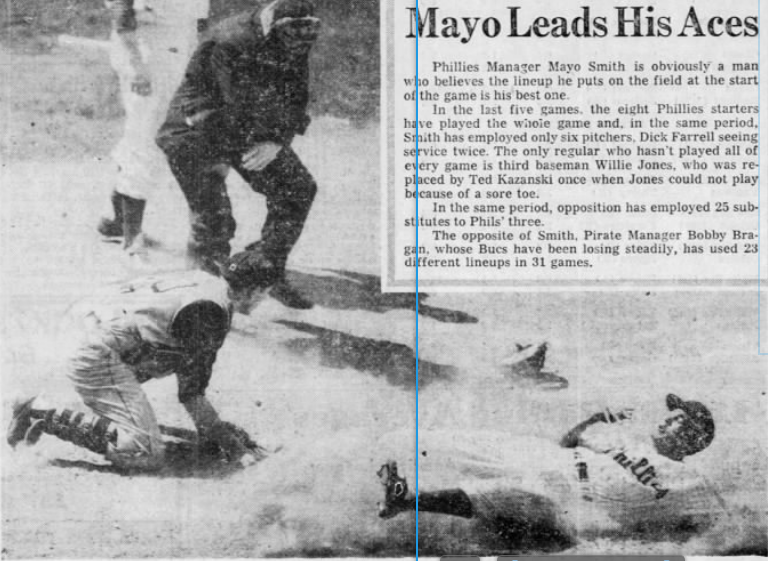
Chico Fernandez steals home, May 25, 1957.

The Tampa Bay Rays Manuel Margot's unsuccessful attempt to steal home against Clayton Kershaw, Austin Barnes and the Los Angeles Dodgers during the fourth game of the 2020 World Series was sure to get fans thinking back to the Dodger Jackie Robinson's successful steal against the Yankees in the eighth inning of Game 1 of the 1955 World Series. For this life-time Phillies fan though, I couldn't help but think back to the audacious steal of home executed by the Phils' new  shortstop Chico Fernandez on May 25, 1957 against the Pittsburgh Pirates. To be sure, this was not the World Series, and these were not two great teams facing off, but the newly acquired (from the Dodgers no less) Fernandez was making a name for himself as a spirited, slick -fielding, and dynamic presence on a team of aging Whiz Kids and never-would-be-kids that badly needed an infusion of excitement.


Let me set the scene. The game was played on a Saturday afternoon at Connie Mack Stadium in Philadelphia. The crowd of 22,414 was one of the largest of the season in the old park and the result of this being both a Ladies Day and Knothole Kids game (ladies and kids get in free). In the bottom of the fourth inning, with the Pittsburgh Pirates leading 4-3, the Phils rallied. Right-fielder Bob Bowman led off with a single and Fernandez, batting eighth, also singled, with Bowman,  going to third. That brought up Phils' pitcher Harvey Haddix and also brought out Buccos manager Bobby Bragan to make a pitching change. Left-hander Bob Smith was brought in to face the lefty swinging Haddix. Haddix struck out, but Richie Ashburn then singled on a hit and run to score Bowman, tie the game, and send Fernandez flying around to third. 

With the feisty Fernandez dancing off third, Granny Hamner took a called third strike. Fernandez, however, saw that the lefty Smith was paying close attention to the speedy Ashburn on first, but not checking at third. Phils' slugger Stan Lopata strode to the plate and as Smith came set, Chico took off. The flustered Smith hesitated and threw late to catcher Dick Rand, who could only trap the low pitch and watch as Fernandez slid safely across the plate with the go ahead run.  The home plate ump, Bill Baker flashed the safe sign and Fernandez rose, dusted himself off, and ran smiling to the home dugout to the waiting congratulations of his teammates and the delighted cheers of the crowd.

The play seemed to unnerve pitcher Smith, who threw ball two to Lopata, and then tossed up a cookie that Lopata deposited on the roof in left field. The Phils went on to win the game 8-6 and Chico Fernandez would go on to win a place in the hearts of Phillies fans everywhere. Headlines the next day, featured Lopata's blast, but also Chico's daring dash.

This was actually the second time Fernandez had tried to steal home in a Phillies uniform. Only a week earlier in St. Louis, Fernandez also beat the throw, but was tagged out when he failed to touch home plate on the way past. The steal of home became symbolic of the joy and abandon with which Fernandez played the game. That abandon often got him in hot water with the manager. Earlier in the season he was guilty of a number of baserunning gaffes, but when you are successful all is forgiven.

Through the years, Fernandez maintained his enthusiasm, but not his batting average. By 1959 , he was benched for newcomer Joe Koppe and in December he was traded to the Detroit Tigers. 

Fernandez managed to resuscitate his career with the Tigers and enjoyed three fairly productive seasons as the starting shortstop there. In Detroit he is also best remembered for a steal of home. On July 4, 1961 in the ninth inning against the New York Yankees at Yankee Stadium with the bases loaded, the game tied, and none other than slugger Rocky Colavito at the plate, Chico took off again. Yankees pitcher Rollie Sheldon threw home, a startled Colavito fell down trying to get out of the way, catcher John Blanchard lurched toward the plate and Chico executed a diving head-first slide, hitting the plate a split second before Blanchard's tag. It was ruled a triple steal with the other runners moving up as well.

The advisability of attempting to steal home with two out and the bases loaded in the ninth inning of a tie game with the team's most feared hitter at the plate might be questioned, but the Tigers won the game, vaulted past the Yankees into first place, and had a play to talk about for all-time, so why question Chico's strategy? It was pure Chico and pure entertainment.

Over his 6+ year major league career, Fernandez attempted to steal home six times and was successful three times. But successful or unsuccessful, Chico Fernandez proved that sometimes doing something a little crazy is just what the doctor ordered for a professional baseball team.


Saturday, September 19, 2020

Joe Lonnett's Miracle Month


If ever a man was central casting for the role of back-up catcher, it was Joe Lonnett. Lonnett played in parts of four seasons with the Philadelphia Phillies from 1956-1959, appearing in 143 games and compiling a microscopic .166 lifetime batting average. Throughout his injury riddled minor league career, Joe had shown he could be a solid .270 hitter. and he was a competent defensive backstop and popular guy in the clubhouse. On the major league level, however,  he rarely got the consistent playing time that might have allowed him to get the timing he needed to be a better hitter. That is until one month in July, 1957, when Joe enjoyed a kind of miracle month when he hit five of his career total of 6 home runs and flashed some of the talent of the player he might have been.

The month was set up by a June 28 right shoulder injury to regular Phillies catcher Stan Lopata. Lopata was a key member of a pretty weak Phillies offense and the injury appeared to many to be the death knell for the team's nascent pennant hopes. Into the pennant race stepped Joe, with a meager two dozen major league games worth of experience in his pocket, to fill the gap until Lopata could return. He responded well.

On July 1 with the Phils mired in a five game losing streak and trailing the lowly Pirates by 4-0, Joe's double started a five run eighth inning outburst that gave the Phils the win. Three days later on July 4th at home in Connie Mack Stadium, Joe celebrated Independence Day with the first home run of his major league career, a two-run  eighth inning shot off the Giants Al Worthington in a 6-2 Phils victory. The next day, Joe singled home a run in a 6-5 loss to the Dodgers and followed that one day later with an RBI double in Phil's win over the Dodgers, this time 9-4.

On July 7, Joe raised his average to .200 going 1 for 3 with a single, but more importantly saved the game with a defensive play. As Allen Lewis of the Philadelphia Inquirer described it, with Dodger runners on second and third, Lonnett took a throw from Granny Hamner at second base, blocked the plate with his left leg and tagged out the speedy Charley Neal with a sweep tag. He then wheeled and doubled up the slow reacting Duke Snider at first for a double play. The Phils eventually won the game 2-1.

Joe's second and third home runs came in the same series, July 11-13 against the Cubs. The Phillies won both games 3-1 and 5-2.  His improbable 4th home run in ten days came off Larry Jackson of the Cardinals on July 14, another Phillies win, 11-4. Joe was 2 for 2 with 2 RBIs, a walk and a sacrifice fly in the game.

Towards the end of July, Lopata was healthy again and Joe returned to his customary place on the bench, but he had one more moment of glory up his sleeve. On July 29, while catching a Robin Roberts shut-out of the Cubs in Wrigley Field, Joe hit his fifth home run of the month. This one was the most improbable of them all, an inside the park homer for the plodding catcher. Joe launched a long high drive down the left filed foul line that fell fair as Cubs left fielder Lee Walls crashed into the ivy covered wall. By the time Walls recovered and threw to relay man Ernie Banks, Joe was chugging home. His slide beat the ball by a whisper, knocking it away from catcher Charlie Silvera.

Thus ended Joe's miracle month. Every one of his home runs came in Phillies victories. His catching and his surprising offense had helped the Phillies stay afloat in the tight National League pennant race. Joe would hit only one more home run in his major league career, two-years later, on July 12, 1959. July, it seems, was his month.

Lonnett went on to have a long and distinguished coaching career, mostly with the Pittsburgh Pirates, where he earned a World Series ring as the third base coach with the "We Are Family" Pirates of 1979. He is remembered by all as a good man and a good baseball man. Dick Allen remembered him as his favorite coach. Former Pirate pitcher and broadcaster, Jim Rooker,  said of Joe, " There are people with big hearts, but Joe had a mega-heart. He was such a wonderful person." Joe died in 2011 at age 84.


Sunday, August 6, 2017

Sweeping the (Boston) Braves, September 1949

Last week, July 28 to 31, 2017 the Phillies swept the Braves in a four game series. Nothing terribly remarkable about this. Two mediocre teams already playing out the string of the long season in midsummer. One thing did catch my attention in this four game sweep, however. This was the first four game sweep by the Phillies of the Braves in Philadelphia since September 2-4, 1949, when the Phillies played at Shibe Park (not to be renamed Connie Mack Stadium for four years yet) and the Braves were playing in Boston (not Milwaukee or Atlanta).

This tidbit of information sent me scrambling to BaseballReference.com to see the statistics from the long ago encounter. In some ways what I found was just as unremarkable: two mediocre teams playing out the string of the long season (Boston had won the pennant in 1948, but was struggling to maintain a .500 record in '49 and the Phillies were showing signs of becoming a good team, but were still 14 games behind the Cardinals at this point.). The Phillies completed the sweep by taking both ends of a Sunday doubleheader (remember those?) in what can only be described as remarkable fashion. This was a doubleheader with some crazy, unprecedented occurrences, great performances by players famous and obscure, a come-from-behind, walk-off home run in one game, starting pitchers who could not get anybody out, and two pitchers pitching multiple innings in both games. This twin bill is a fascinating look at how the game has both changed and stayed the same over the past 70 years.

Let's start with the unprecedented. The Phillies won both games of the doubleheader despite having their starting pitchers get a grand total of one out and despite falling behind by 4-0 in both games before they ever came to bat. In the first game, Hank Borowy, well past his prime as the star of the 1945 Cubs pennant winners, faced five batters, gave up two hits, two walks, and four runs. The only out he got was on a Sibby Sisti sacrifice bunt. As bad as Borowy was, he out-pitched the Phillies starter in the second game, Blix Donnelly. Blix gave up a walk and four hits, including a three run home run to the Braves third baseman, Bob Elliot, and was gone without retiring a batter. To sum up: two games, two starting pitchers, ten batters faced, one out recorded, six hits, three walks, one double, one home run, eight runs allowed. I cannot find one other example of a team who won both ends of a double header when their starting pitchers recorded only one out total.

That the Phils were able to come back and win both games was largely due to some excellent relief pitching from Curt Simmons and Ken Trinkle. Regular Phillies fans are likely to recognize the name of Simmons, who was the top left-handed pitcher for the team in the Whiz Kid days, before becoming a stalwart for the very good '60s Cardinals teams.  Ken Trinkle is probably not on your radar. Trinkle was a relief pitcher with the Giants in the forties, before landing with the Phillies in a cash transaction for his final season in the majors in 1949.

Simmons pitched 3.2 innings in the first game without giving up a run and allowing the Phils to catch up. He was right back out on the mound in the second game pitching 4 more innings, giving up two runs, but this time finishing off the game and picking up the win. At this point in his career, Simmons was a twenty-year-old phenom who was still trying to find his bearings. It is hard to imagine a team in 2017 pitching their rising star in back-to-back games of a doubleheader for multiple innings as manager Eddie Sawyer of the Phillies did here.

Meanwhile, Trinkle pitched a scoreless ninth inning in the first game, picking up the win when Willie "Puddin' Head" Jones cracked a two out, two run, walk-off home run to the left center field bleachers, driving home Bill "Swish" Nicholson, who had doubled, ahead of him. Trinkle then went out in the second game and replaced Donnelly, pitching an additional five innings, giving up only one run on a Marv "Twitch" Rickert home run.

The Braves, by the way, ran out two much more heralded pitchers in Johnny Sain and Vern Bickford. But this was not a day for starting pitchers. The usually dependable Sain threw just 3.2 innings and gave up six hits and five runs. In the second game, Bickford allowed 12 hits and six runs in 5.1 innings.

The two games featured plenty of offense from both teams. The final scores were 9-8 and 8-7. The teams combined for 32 runs and 49 hits on the day. Future Hall of Famer Richie Ashburn, had six hits, including a triple, while first baseman Dick Sisler had five hits including a home run and a double. Granny Hamner, Del Ennis, and of course, Jones also homered for the Phils. In addition to Elliott and  Rickert, Tommy Holmes and Connie Ryan homered for the Braves.

The two teams also featured a sort of All Stars of Nicknames contest, fielding the following players with these colorful monikers.

Willie "Puddin' Head" Jones
Bill "Swish" Nicholson
Richie "Whitey" Ashburn
Marv "Twitch" Rickert
Eddie "The Brat" Stanky
Ed "Horn" Sauer
Sebastian "Sibby" Sisti
Elburt "Elbie" Fletcher
Charles "Red" Barrett
Stan "Stash" Lopata
Sylvester "Blix" Donnelly
Robert "Buddy" Blattner
"Pistol" Pete Rieser
Tommy "Kelly" Holmes
Cornelius "Connie" Ryan
Lynnwood "Schoolboy" Rowe
Granville "Granny" Hamner

All in all a great day to be at the ballpark.

Tuesday, July 8, 2014

Missing "Wheels"

Last fall as part of a new and lucrative television deal with Comcast, the Phillies dumped long-time broadcaster Chris "Wheels" Wheeler, along with relative johnny-come-lately Gary "Sarge" Mathews. When the change was finally announced over the winter there was little hue and cry from the normally passionate Philly fans. Despite being in the Phillies broadcast booth for 37 years, Wheeler never garnered the fan worship accorded former broadcasters Harry Kalas or Richie Ashburn. In fact, the opposite was true. With the possible exception of Andy Musser, Wheeler was the most disliked Phillies announcer of the last 50 years.

The reason for all the vitriol aimed at Wheeler can be attributed in part to the widely reported feud with Kalas. The feud started with Ashburn believing that Wheeler was out to undermine him and confiding in Kalas. Kalas' second wife also seems to have had a role to play, accusing Wheeler of facilitating Harry's philandering and of undermining Harry "subliminally" in the braodcast booth. Kalas and Ashburn were at a stage of their careers when they were beyond criticism, so Wheeler was the clear loser in this bit of nastiness. Kalas went public with his distaste for Wheeler, a former close friend, saying he was uncomfortable working with Wheeler.

Wheeler was also always open to the accusation that he had never played baseball beyond high school, did not have a classic broadcaster's voice and had a personality that could be prickly. It may not have helped him, either, when Tim McCarver came riding to his defense, saying Wheeler is "one of the finest people I know." McCarver has not exactly endeared himself with the public over the past few years in his Game of the Week duties for Fox Sports.

So there were many reasons for a lack of public outcry when Wheeler was so artlessly dismissed. After watching half a season of Phillies baseball with Wheeler's replacements, Jamie Moyer and Matt Stairs, however, I am ready to say that that I would greatly prefer Wheels were still in the booth.

Whatever his shortcomings, Wheeler was always professional, knowledgeable and articulate. I have been around the game as player, spectator and coach for sixty years, yet I found that Wheeler had insights into the game that were profound and telling. Wheels did his homework. Because he was so close to the team, he had access to special insights. Unlike Tom McCarthy he did not come across as fawning over the players, but gave you what seemed to be the straight dope.

The absence of Wheeler hasn't helped Tom McCarthy either. With Moyer and Stairs learning on the job, it has fallen to McCarthy to set them up for analysis.  McCarthy is very professional, if a bit too saccharine, but he really does not know the game well and sometimes his set ups are awkward. Moyer appears to be working hard at the job, but his only real insights are in pitching and catching fly balls with two hands and he tends to perseverate on whatever is bothering him. Stairs is a great guy who is very inarticulate and does not come off as close to professional in the booth.

So I miss Wheels. It is tough enough watching this team play right now, without also having to listen to two ex-players stumble their way through on-the-job training. Wheels was a pro who enhanced my enjoyment of the game. That is what a broadcaster should do.


Monday, June 9, 2014

Jim Bunning’s Father’s Day Perfection

I received a terrific birthday gift form my wife, Cindy, yesterday: an autographed, framed photo of Jim Bunning in the process of making the last pitch of his perfect game against the New York Mets on Father’s Day, June 21, 1964. We are just a few days away from the 50th anniversary of that event, and it brings back special memories for me, at the time a just-turned 17 year-old about to begin my senior year of high school. I saw the game, sort of.

In those pre-cable days, there were not nearly as many games broadcast on television. In fact, the only day you could really depend on a televised Phillies game was Sunday. My memory of the game is also in black and white, because, though color TV had been invented, very few households that I frequented had a color set.

I watched the first three innings of the game at home with my dad on our old console Philco TV, while simultaneously getting dressed for our Father’s Day trip for Sunday dinner at my grandparent’s house. There was no excitement about the game yet, just a typically good outing from Bunning. After three innings, my dad, mom, two sisters and brother all climbed into the copper-colored Ford station wagon for the trip from Levittown to the Juniata Park section of Philly.

Interstate I-95 had just opened from Bristol down to Castor Avenue in Philly, so the ride that formerly took an hour or more, had been reduced to about 45 minutes - good thing. We listened to three innings of the game in the car and by then things were getting exciting. We knew by then that Bunning had a perfect game. Not that the announcers were any help. Holding to long held tradition, announcers Bill Campbell, By Saam and Richie Ashburn refused to mention what was happening.

You would get little clues, like “Looking up at the scoreboard, we see nothing but zeroes for the Mets.” Or, “Bunning is really pitching a classic today.” But no one said the words “no-hitter” or “perfect game.”

In the dugout, Bunning did not stand on tradition. He was chatting about the perfecto from the fifth inning on. Johnny Callison (who would homer in the game) said, “You don’t talk about a no-hitter right? But [Bunning] was going up and down the bench telling everybody what was going on. Everybody was trying to get away from him, but he was so wired he would follow us around.”

I clambered out of the car and ran into my grandparents’ house, waving a quick, “Hello”, to my grandmother in the kitchen and making a beeline for the den, where I knew I would find my grandfather sitting is his red leather Morris chair, smoking a Lucky Strike, and watching the Phillies game. Sure enough as I entered the smoke filled room, he said, “You better sit down, kid, Bunning’s got a no-hitter going.”

It’s a perfect game, Dad.” My father said, joining me on the couch.

“Right. How about that.”

In those days, perfect games were so rare that few people were fully aware of them. Even the home plate umpire, Ed Sudol, did not realize Bunning was pitching a perfect game until he was told so by Mets announcer, Ralph Kiner, after the game. “Do you mean I umpired a perfect game?”, he asked.

It had been eighty-four years since a perfect game in the National League. That one was pitched by a young right-hander named John Montgomery Ward for the Providence Greys. In 1956, Don Larson of the Yankees famously pitched a perfecto in the World Series, but in the American League the last regular season perfect game was in 1922. In 1964, perfect games were the rarest of all baseball feats.

On the television it was the bottom of the seventh and Bunning was 9 outs away. Pesky Ron Hunt of the Mets ripped a ball to third that was fielded nicely by rookie Richie Allen and Bunning was 8 outs away. Hunt’s smash was one of only two hard hit balls by the Mets all day. In the fifth, while I was in the car listening on the radio, Phils’ second baseman, Tony Taylor, made the play that saved the day. Met catcher, Jesse Gonder, hit a hard two-hopper to Taylor’s left. Tony dived, snagged the ball, leapt to his feet and threw out Gonder at first.

Bunning made easy work of the Mets in the eighth. In the ninth he knew he would face two left-handed pinch hitters, George Altman and John Stevenson. Altman was a powerful, dangerous hitter. Bunning hoped to get Altman before Stephenson. This is how Bunning told it after the game.

I knew if I got Stephenson up there with two out, I had it. I knew I could get him out on curve balls, no matter what. Altman, I wasn’t so sure of. I didn’t know if I could still jam him with the ball.

Bunning retired the first hitter in the ninth, former Phil Charley Smith, on an easy pop-up to defensive replacement Bobby Wine at short. Then, as he hoped, George Altman strode to the plate. My grandfather muttered a quick, “Uh, oh.” I was too nervous to speak.

At this moment my grandmother yelled back from the kitchen, “Dinner’s ready.” Her call was greeted by a chorus of male voices young and old, “Not now!”

Altman launched a high fly ball to right that Johnny Callison chased, but it drifted into the stands, foul. Strike one. Altman fouled off the next pitch. Strike two. Bunning next delivered a curve ball that looked like it stopped half way to the plate. Altman swung hard and early and missed. Five curve balls later John Stephenson became Bunnings 10th strikeout victim and the perfect game was complete.

Bunning slapped his pitching hand to his mitt, while what Mets announcer Bob Murphy called his “happy teammates” came out to congratulate him. The celebration was mild by today’s standards, but it was clear that Bunning knew what he accomplished.

And so did I. I watched a perfect game, even if only on TV, on Father’s Day, with my father and my grandfather.

We all adjourned to dinner with plenty to talk about.

To top it off, later that evening we all sat around the TV to see Jim Bunning, local hero, appear on the Ed Sullivan Show. Things were good in Phillies land.

A little later in the year of 1964, things were not so good, but that is a story for another day.


Monday, June 2, 2014

Booing Del Ennis

In looking back at his record for the Philadelphia Phillies, Del Ennis would appear to have all the makings of the ultimate local hero. Ennis was born and bred in Philadelphia. He graduated from Olney High School, he turned down a big money (for the time) offer from the Yankees to play for the Phillies and he was an outstanding player and one of the greatest sluggers in Phillies history. Yet instead of becoming the hero he richly deserved to be, Ennis was booed unmercifully by Phillies fans throughout much of his career here.

Let's first provide a little context. Del Ennis was signed in 1942 out of Olney High by the Phillies and played one season at Double AA Trenton before enlisting in the Navy during World War II. Upon his discharge from military service in 1946, he joined the Phillies and was an immediate success, hitting .313 with 17 homers and 73 RBIs in his rookie season. Ennis was named to the National League All-Star team.

Over the next ten years with the Phillies, Ennis was a consistently reliable slugger, averaging 25 home runs and 109 RBIs, with a very respectable .286 batting average. To this day, Ennis ranks behind only Mike Schmidt and Ryan Howard in Phillie home runs, behind Schmidt and Delahanty in RBIs and in the top 10 in nearly every conceivable offensive category including hits, runs, doubles and even, incredibly, triples.

On the 1950 Whiz Kids team, Ennis was the primary offensive threat. As indispensible as Robin Roberts and Jim Konstanty were to that team,the Phillies would not have won the pennent without Ennis' heroics. He hit .311 that year, with a career high 31 home runs and a league leading 126 RBIs.

So why the booing for this certifiably outstanding local slugger? Phillies fans are famous for their booing, and especially for the booing of sluggers. Schmidt, Dick Allen and Pat Burrell were all targets of vociferous boo birds at various times in their careers. But Schmidt, as great as he was, could be wildly inconsistent at the plate and a bit enigmatic with the press and public. Phillie fans don't like their athletes introspective. Burrell, too, was maddeningly inconsistent and in his later years,  a defensive liability. Allen, as the first great African American Phillie player, had a target on his back from the start and tended to garner negative publicity for his off field activities.

But what can we point to in Ennis? He was certainly no gazelle in the outfield, with a lumbering gate that made him look more awkward than he actually was. Eddie Sawyer, manager of the Whiz Kids, said "He was a good outfielder, had a good arm and ran good for a big man." In truth, Ennis did make quite a few errors in the outfield. Robin Roberts remembered that he once dropped a routine fly ball with the bases loaded, inviting a chorus of boos that could be heard all the way up in Bucks County. The next day he hit a grand slam to win the game.

Nothing can invite booing in Philadelphia like lack of hustle. Jimmy Rollins hears the boo birds on those occasions when he fails to run out a ground ball. By all reports Ennis was a full out hustler all the time. Richie Ashburn said, "Del played every game as hard as he could. He hustled all the time. He hustled like Pete Rose, but he never looked like he hustled that much." Maybe their is a clue in that last part of what Ashburn said. Ennis didn't appear to be hustling. In Philadelphia you not only have to hustle, you must also look like you are hustling. Long-time Phillie coach, Maje McDonald, said "Del loped in from the outfield, Ashburn dashed. Del looked like he wasn't trying, but he was one of the toughest and hardest-working guys we ever had."

What about strikeouts? The image of the big slugger striking out with the game on the line has invoked boos since mighty Casey was at the bat. Like most sluggers, Del struck out some, but not at the level of most sluggers. In fact, Ennis never struck out more than 65 times in a season. For perspective, Ryan Howard has struck out 68 times as of June 1, 2014, after one-third of a season.

According to Ennis' wife, Liz, the booing really did bother him. 

"The booing was hurtful to him. It really was. Every time he was interviewed, the very first question everybody would ask is, ‘Why did the fans boo you like they did? He always said that as long as they paid money to get into the ballpark, they were entitled to boo. But the fact of the matter was, he didn’t understand it. He really didn’t understand it. And I don’t either.”

Make no mistake about it, the booing Ennis endured was prodigous. Here is how his wife Liz remembered Del's comments about it.

"When there was a lot written about Mike Schmidt being booed, Del couldn't believe it. He'd say, 'They think that is booing? That's nothing.' He didn't think that was anything compared to what he got every game, every at-bat, every move he made."

In retirement, Ennis seemed to be more famous for being booed than for being a great player. The first question out of every reporters mouth was about the booing and not about his near Hall of Fame worthy career. The booing came to define Ennis more than his considerable on field achievements did. His number fourteen was retired by the Phillies to honor Jim Bunning, the Hall of Fame pitcher who wore the number in the 1960s. No such honor has been afforded Ennis.

So, there you have it. Fine player, all-out hustler, consistent performer, RBI machine, pennant winner and target of unremmitting boos. After the 1956 season the Phillies traded Ennis to St. Louis where he enjoyed his final stand out season. When he returned to Philadelphia for the first time, the fans stood and cheered and cheered. As Joni Mitchell says in the song, "Don't it always seem to go, you don't know what you've got 'til it's gone."

As to those thousands of fans who mistreated Del Ennis over the years, I have just one word for you, "Boo."


Friday, May 30, 2014

The Making of a Phillies Fan

The date was July17, 1953. My grandfather and I boarded the 36 trolley at Erie and Lycoming Streets in the Juniata Park section of Philadelphia on our way to the Broad Street subway and then 21st and Lehigh Avenue for a Phillies game at what my grandfather still called Shibe Park, even though it had been renamed Connie Mack Stadium earlier that year. As we walked from the subway to the stadium by way of a railroad underpass, I can remember vendors selling Phillies gear and huge balloons that were white splotched with red. We entered the gates of the aging edifice, bought some popcorn and made our way to our seats down the left field line. Coming out of the bowels of the dank stadium into the bright artificial light I got my first glimpse of a major league ballpark.

The field at Connie Mack Stadium was the greenest, green I had ever seen. I stared out over the lush landscape, mouth agape, as if my grandfather and I had just entered into Oz. The Phillies players in red pinstriped and woolen uniforms with huge numerals on the back stood out like ruby red slippers on the green grass under the brilliant lights. As Richie Ashburn, the great Phillie center fielder of the 50’s would recall, "[Shibe Park] looked like a ballpark. It smelled like a ballpark. It had a feeling and a heartbeat, a personality that was all baseball."

Before we even got into our seats, number 14, Del Ennis, had rocketed a ball off the left field fence for a double. I could hear the crack of the bat and the thwack of the ball off the old wooden fence as clearly as if I were alone in the park. Mel Clark scampered home from second as the crowd rose to cheer. I held my grandfather’s hand and we made our way through the cheering fans to our seats.  I knew right there that I had entered into my own little contained heaven. That evening a Phillies fan was born.

By the way, the Phillies lost that game, which was probably a good introduction to a new fan of what life was going to be like for the next 60 years. On July 15, 2007, nearly 54 years to the day I became a fan, the Phillies famously became the first team in major league history to lose 10,000 games. In part this was a tribute to their longevity; the team had been around since 1883 , but it was also a testament to the team’s futility. If we count from that July day in 1953, the Phillies had lost 4,558 of those ten-thousand, nearly half, while I was rooting for them. Now it takes some resilience and perhaps some willing suspension of reason to remain a fan of this team of legendary losers.

But it is one of the perversities of fandom that I never saw them as losers. I never viewed the coming season with dejection, the slow April start as a harbinger of more bad things to come, the latest bust of a pitching or hitting prospect as business as usual. I just kept my head down and my spirits up and I kept on rooting. I was a fan. This was my team and while I could engage in criticism of the team with other Phillie fans, woe betide the Yankee or Dodger or Met fan who had a bad word to say about our squad. Because there it is you see, this was our squad, our players and they were and remain inextricably linked with our identity as a city as the Liberty Bell and Ben Franklin and cheesesteaks. The Phillies are a part my personal identity as well.  This is what makes for the faith of a Phillies fan.