Sunday, January 24, 2021

Henry Aaron: Phillie Killer


Henry Aaron was probably the single most famous person I ever got to meet personally. In 1978 or 79, about a year or so after he had retired from baseball as the all time home run champion, Aaron appeared at a luncheon at the old Alvino's Restaurant in Langhorne, PA. As the coach of the Bristol High School baseball team, I was invited to bring some of my players and attend the luncheon. There we got to shake hands with the great man and pose for a group picture with him. I don't now remember the topic of Aaron's talk, but I remember how he spoke: quietly and with dignity, just the way carried himself as a ballplayer for so many years. 

Many people may remember Aaron as the prolific home run hitter that he was. The image of the aging star turning on an Al Downing fastball and launching it over the fence for home run 715, breaking Babe Ruth's record is burned in most of our minds. For me, however, who was lucky enough to have seen Aaron play in the late 1950s and early 1960s, Aaron was the consummate line drive hitter, slashing base hits to every part of the ballpark and often hustling them into doubles and triples. Many of those line drives also left the park, of course, but they were almost always line drives, not those long majestic bombs hit by other sluggers of the day like Harmon Killebrew or Mickey Mantle. 

Perhaps that is why Aaron suddenly sneaking up on Ruth's record came as a surprise to many. He never had huge home run numbers; the most he ever hit was 47. What Aaron was was a consistent hitter. Probably the most consistent power hitter in baseball history. While he never hit 50 homeruns in a season, he hit 30 or more in 15 of his 23 seasons and exactly 44 homeruns (the number he wore on his back) four times.

As a lifelong Phillies fan, what I mostly remember about Aaron is how often he seemed to beat the home team. For his career. Aaron hit .318 against the Phillies pitchers with 76 home runs. Connie Mack Stadium was one of his favorite away ballparks. He hit 39 home runs there, topped only by Chicago's Wrigley Field (50) and Cincinnati's Crosley Field (43). Remarkably, Aaron hit 16 triples in old Connie Mack, seven more than he hit at any other away ballpark. This reinforces the view of Aaron as a line drive hitter with speed. Connie Mack had a spacious outfield that gave the advantage to a guy who hit the ball on a line in the gaps.

Aaron had some special games at Connie Mack Stadium like the night of June 14, 1957 when he went 3 for 5 with a homerun and 4 RBIs in a 10-5 Braves win. Or the night of May 22, 1959 when he had four hits including a two-run home run off Robin Roberts,  scored 4 runs and knocked in 3 more. And then there was the May 30, 1961 game when Aaron's eighth-inning triple drove in the 2 runs that were the difference in a Braves 3-1 victory. In a 5 game series against the Phillies in July of 1962 Aaron compiled 9 hits, 2 home runs, and 6 runs scored. In a three game series in 1968 he collected 8 hits, including 2 home runs. Aaron had a 2 home run game at Connie Mack on April 20, 1966. The second home run that day, off Bo Belinsky, was the 400th of Aaron's career. Two years later, on July 26, 1968, he would hit career number 501 at Connie Mack off Grant Jackson.

Aaron's greatest day at Connie Mack Stadium came on Thursday night, May 3, 1962. It started with a solo home run against Art Mahaffey in the first. Aaron led off the 3rd with one of his patented Connie Mack Stadium triples and then scored on a Joe Adcock sacrifice fly. Aaron doubled in the fifth, before striking out in the 7th. He finished off the evening with a two-run home run in the 9th off Phils reliever Jack Baldschun, to tie the score at 8-8. The Phillies finally won the game in the bottom of the ninth when Clay Dalrymple singled home Johnny Callison. Aaron's line for the night: 5 AB, 3 R, 4 H, 3 RBIs, 2B. 3B, 2 HRs.

To be fair to the Phillies though, virtually every team that Aaron played against in his prime could point to similar numbers. He batted .326 for his career against the Cubs and swatted 97 home runs against the Reds. Henry Aaron was simply a great hitter. I was lucky enough to see Mays and Aaron close up in their primes. Mays was certainly the more charismatic player on the field, but as one wag once said, "Aaron could do everything Mays could do, but his cap stayed on."


Wednesday, January 13, 2021

Robin Roberts Amazing 17 Inning 300 Pitch Performance


 In 1952, Robin Roberts was unquestionably the best pitcher in baseball. He won 28 games and lost only 7. He won 20 of his final 22 starts and 17 of his final 18. He completed 30 of the 37 games he started and threw 330 innings, the most in the league in 25 years. Over those 330 innings he walked only 45 batters. All of these were remarkable accomplishments, of course, but in a September game against the Boston Braves when he wasn't at his best, he may have turned in his most remarkable single performance.

Robbie was looking for his 23rd victory of the year when he took the mound on Saturday afternoon September 6 in the first game of a double header. He did not have his best stuff.  The Braves scratched out two runs in the fourth inning and then scored another three in the sixth inning on three hits and a pair of Phillies errors. The Braves 6th run of the day came on an Eddie Matthews home run in the eighth inning. The Phillies rallied, however, and tied the score with four runs in the bottom of the eighth on five hits; the big blow being a two run, two RBI Jackie Mayo double.

Roberts shut down the Braves in the ninth with the help of the Phillies defense catching Johnny Logan trying to score from first on a single by Earl Torgeson. The Phillies went down quietly in the ninth and Roberts walked out to the mound as the game went into extra innings. The Braves managed to get runners on in each of the next 8 innings except for the 17th. Each time, Roberts wriggled out of trouble. In the 12th inning, Boston opened with back-to-back singles by Sid Gordon and Earl Torgeson. Roberts then fielded Matthews bunt and threw out Gordon at third. He then induced a double play grounder from pinch-hitter Walker Cooper. In the 15th Jack Daniels led off with a double and moved to third on Jack Ditmer's long fly ball. Roberts worked out of it by striking out pitcher Bob Chipman and getting Sam Jethroe to ground out to first. 

Meanwhile, the Phillies were flailing futilely at the offerings of left-handed reliever Chipman. They managed only a couple of singles from the 10th through the 16th. Finally, in the bottom of the 17th inning, Phillies slugger Del Ennis came to the plate and belted a line drive over the fence in left. Pandemonium broke out in the ballpark. Final score: Phillies 7 Braves 6. A weary Roberts had his 23rd win of the season.

A look inside the numbers shows just how remarkable this performance was. His 17-inning complete game was the longest complete game victory by any pitcher since Dizzy Dean pitched a 17-inning win in 1934 and there has not been a pitching performance to match it since. Vernon Law of the Pirates did pitch 18 innings in a game he started in 1955, but he was pulled from the game before it ended in a Pirate victory in the 19th. Roberts not only pitched a 17-inning complete game, but he was pitching his way out of trouble the whole way. He was touched for a total of 18 hits; he walked 3 and struck out 5. In all he faced an astounding 71 batters. Major league baseball did not keep track of  pitch counts in those days, but a rough estimate of an average of 4 pitches per batter would mean that Roberts threw close to 300 pitches for the game. Robbie was a workhorse though. He made his next start four days later on regular rest, a 3-2 complete game victory. It was like his teammate Curt Simmons said of him, "He was like a diesel engine. The more you used him, the better he ran. I don't think you could wear him out."*


*The National Baseball Hall of Fame Almanac, Durham: Baseball America, 2017 Edition), 370.


Tuesday, December 29, 2020

Rollins' Rousing Triple: September 30, 2007


I have had the good fortune to see many great games and many great plays in person over my 70+ years of being a baseball fan. I have seen games to clinch the World Series and games to clinch pennants. I have seen Dick Allen hit a home run over the roof at Connie Mack Stadium and Roy Halladay throw a playoff no-hitter. But one play, more than any other, stands out as the most exciting play I have ever witnessed in person. That play was Jimmy Rollins' thrilling triple on the final day of the 2007 season.

First some context. The Phillies of 2007 were a fast improving team with stars Ryan Howard, Chase Utley, and Rollins, and a blossoming ace pitcher in Cole Hamels, but they had  yet to come together as a pennant contender. The previous year, the New York Mets had run away with the division, finishing 12 games ahead of the second place Phils. Nonetheless, in February of 2007, Rollins boldly, many would say foolishly, declared the Phillies the favorite in the National League East. "Bottom line, we're the team to beat," said Rollins, "I can't put it any other way."

Despite Rollins best efforts, and they were indeed great efforts in this Rollins' MVP year, the Phillies found themselves 7 full games behind the Mets on September 12.  The Phillies then went on a furious run, winning nine of ten to find themselves in a dead heat with New York on the final day of the season. If both teams won or both teams lost a playoff loomed. If the Phils lost and the Mets won the  Phillies season was over. If the Phils won and the Mets lost, the Phillies were in the playoffs for the first time in 14 long and mostly lean years.

As my friend and fellow Phillies fanatic, Don, and I worked our way to our usual Sunday afternoon seats down the first base line in Citizens Bank Park, excitement was building. The Mets game in New York started about twenty minutes before the Phillies game. As we sat down, the right field scoreboard flashed the score in New York. The lowly Marlins had put up 7 runs against Tom Glavine and the Mets in the first inning. This was the best possible scenario imaginable. The Mets looked headed for defeat even before Jamie Moyer took the mound for the Phils against the Washington Nationals. 

From there the day played out like one long celebration. The Phillies took the lead in the bottom of the first when Rollins singled, stole second and third, and scored on an Utley sacrifice fly. In the third a Carlos Ruiz double, a Rollins walk, and a Ryan Howard single plated two more runs. In the fourth inning a Gregg Dobbs error at third lead to an unearned run and the game stood at 3-1 Phils. Meanwhile the Mets were getting no closer to the Marlins in New York, where the score stood at 8-1 moving to the seventh.

In the bottom of the sixth, Pat Burrell walked to lead off the inning and the speedy Michael Bourne ran for him. Chris Coste, who had replaced Ruiz as catcher after Carlos was hit by a pitch earlier, was then also hit by a pitch. With runners at first and second, Abraham Nunez (in as a defensive replacement for Dobbs at third base) put down a sacrifice bunt to move the runners to second and third. Tadahito Iguchi then batted for reliever Tom Gordon and launched a sacrifice fly to deep right center that scored Bourne from third and moved Coste up to third. With a man on third and two outs, Jimmy Rollins strode to the plate. 

Rollins, the prognosticator of Phillie success from February, was having a career year. His offensive numbers were off the charts. As he climbed into the batters box he had amassed 38 doubles, 30 home runs, 41 stolen bases, and 19 triples. One more triple would make Rollins a member of one of baseball's most exclusive clubs: the 20-20-20-20 club. Only Frank Schulte (1911) Willie Mays (1957) and Curtis Granderson (also 2007) were members. Statistically aware fans were hoping against hope that Rollins would get a triple on this day to round out a near perfect year for the little shortstop. More important was getting some kind of hit to get the fifth run across the plate.

Rollins, batting left handed against Nationals righty, Luis Ayala, worked the count to 3-2, fouling away a couple of pitches. He then laced a ringing line drive down the right field line for a hit, Coste scored easily, and Jimmy was off and running in his familiar arms-pumping, legs churning style. The hit was a sure double, but everyone could see that Rollins was thinking triple out of the box. As he rounded second and took off for third, I pounded Don on the back and shouted, "He's going to go for it."  The outcome was far from a foregone conclusion. The ball clattered against the fence and hopped over the head of Nationals right-fielder. Austin Kearns who chased it down and threw to the cut off man, second baseman Ronnie Belliard who wheeled and launched a strong throw to third. As Rollins dived for the bag, third baseman Ryan Zimmerman caught the ball on one hop and slapped down the tag a whisper too late. Umpire Bruce Dreckman emphatically signaled safe and the crowd went bonkers. Don and I slapped high fives with everyone within our reach.

A few innings later, the Mets had lost, Brett Myers had struck out Willie Mo Pena for the final out of a 6-1 victory and the Phillies were on the way to the playoffs.

Knowledgeable baseball people have long said that the triple is the most exciting play in baseball. On this day, for this fan, watching this marvelous player, this triple was indeed the most exciting play I ever saw. It was the perfect exclamation point on an extraordinary season for a team and its inspirational leader.


Friday, December 4, 2020

Curt Simmons Spectacular Debut: September 28, 1947


The death of pitcher Bob Miller last week, means that only one member of the 1950 Whiz Kids survives, lefty hurler, Curt Simmons. Simmons was a key member of the 1950 pitching staff, going 17-8 during that pennant winning season. Unfortunately late in the year, he was called up to active duty in the army and was not available to pitch in the World Series. Simmons was a hometown boy, of sorts, having grown up in Egypt, PA, near Allentown, about 70 miles from Philadelphia's Shibe Park. Although he was only 21 years-old in 1950, Simmons was already a veteran of the Phils staff, having been a regular part of the rotation since 1948. Simmons made his debut with the Phillies on a memorable September Sunday in 1947 at the age of 18, only months out of high school, in a game that kept Phillies fans talking about Simmons potential throughout the long winter.

Simmons debut was eagerly anticipated. He had been the most sought after pitcher in the country after showing off his blazing fastball in high school and American Legion competition. In 1945 he had been named "All-American Boy" in Philadelphia after pitching in a Legion All-Star game there. Ty Cobb and Babe Ruth, who managed those teams, called him the greatest young ball player they had ever seen. After signing with the Phillies, he was assigned to their affiliate in Wilmington, DE where he took a seventh place team and pitched them into the playoffs with a 13-5 record, and then won two games in leading them to the league championship. The next day, Simmons was called up to the big club.

A crowd of more than 14,000 showed up on Sunday, September 28, 1947 to see a meaningless double-header on the last day of the season between the seventh placed Phillies and the fourth placed New York Giants. The fans were there to see Simmons, who was scheduled to pitch the second game. Thrust on to the big stage at a very tender age, Curt did not disappoint, dominating the Giants from start to finish, pitching a complete game, and leading the Phils to a 3-1 victory.

Philadelphia Inquirer reporter, Stan Baumgartner enthused that Simmons used "a fastball that was so alive it occasionally squirted out of catcher Andy Seminick's glove and a curve that broke like a jug handle" to keep the slugging Giants at bay. The Giants featured the major league leading home run hitter Johnny Mize, who clubbed 51 that year, as well as Bobby Thompson (28) and Willard Marshall (36). None could manage more than a weak single off Simmons, who gave up just five hits (4 singles and a double) and struck out nine. The only blemish on the pitching record for the day came in the ninth inning, when with two outs,  two walks and a Buddy Blattner pinch-hit single ruined the shut out. Simmons then finished up in style by retiring the heavy-hitting Mize on a routine ground ball to second base. 

When it was all over thousands of youngsters streamed out of the stands like it was the seventh game of the World Series surrounding Simmons and. according to Baumgartner, "practically pushed him along the grandstand to the clubhouse." For his part, young Simmons was modest and composed in speaking about the victory. "I was a bit nervous, always am, before a game. After it started I just told myself it was just like Wilmington - just another game. And that is really all it was. Andy Seminick did a great job behind the bat for me. He seemed to know just what to call and three times when I broke the curve ball in front of the plate with men on he made great pick ups. The boys fielded well behind me, too. Just tell all my friends in Egypt and all the Phil fans that I am very happy I got such a fine start." 

Great talent, great poise, and the ability to talk to the media. Eighteen year-old Curt Simmons was a rising star indeed.

If Simmons did not quite fulfill all of the promise he demonstrated on that distant Sunday afternoon, he certainly became a very fine major league pitcher for a very long time. Over a twenty year career, often interrupted by military service and injury, Simmons compiled 193 wins. and eventually did get to pitch in the World Series at the age of 35 with the 1964 World Champion St. Louis Cardinals.


Monday, November 2, 2020

Humberto Robinson Foils a Gambler's Gambit


This article is adapted from the Humberto Robinson biography I wrote for the Society for American Baseball Research.

When the 24 year-old Humberto Robinson appeared on the mound for the Milwaukee Braves on April 20, 1955, the side-winding right-hander was the first Panamanian ever to appear in the major leagues. After several up and down seasons in Milwaukee, Humberto was first traded to the Cleveland Indians and then to the Philadelphia Phillies in the space of one month in 1959. 

The 1959 season turned out to be Robinson’s best, and only full, season in the major leagues. Thriving on the regular work he had sought but never received in Milwaukee, "Berto", as his teammates called him, ended the season with a combined 36 appearances, 81 innings pitched, a 3-4 record (including 1-0 with the Indians) and a respectable 3.42 ERA.

The season proved eventful for another reason as well and that story got Robinson’s name into the newspapers across the country and into the annals of baseball lore permanently. On September 22, with the Cincinnati Reds in town, the Phillies were scheduled to play a twi-night doubleheader. Both teams were playing out the string in losing seasons. Robinson, who was being used as a starter at the end of the season amid injuries to the Phillies starting staff, was scheduled to pitch the second game.

The night before the game, Robinson was approached by Harold “Boomie” Friedman in the bar of the Warwick Hotel. Friedman was part-owner of the Moon-glo Supper Club in Philly, a popular, if unsavory, hangout for major league baseball players. “Boomie” was well-known to Robinson and many of the Phillies players. According to a complaint filed in Philadelphia Municipal Court, Friedman offered Robinson $1,500 dollars to “throw” the game. Robinson rejected the offer and later witnesses said that he was visibly upset and crying in the bar after the meeting.

The next morning, Robinson told the court that Friedman appeared in the pitcher’s room in the Rittenhouse Hotel and threw a “down-payment” of $200-300 dollars at Robinson. Robinson again rejected the money, told Friedman to fish it out of the water basin where it had fallen and asked him to leave.

When he arrived at Connie Mack Stadium, Robinson told fellow Phils pitcher Ruben Gomez about the incident between the games of the doubleheader. Gomez informed Phil’s manager Eddie Sawyer during the fifth inning of the second game, while Robinson was on the mound. Following the game, Sawyer informed Quinn, who in turn informed Baseball Commissioner, Ford Frick. Frick passed the information to Philadelphia Police Commissioner Thomas Gibbon.

As it turned out, despite his emotional upheaval after the bribe attempt, Robinson went out and pitched one of the best games of his career. He hurled seven innings of three hit, two-run ball, and was the winning pitcher in the Phil’s 3-2 decision. Just before he took the mound for the game, at the moment he told Gomez about the bribe attempt, with his voice shaking he said, “I am going to win the game.” Then he went out to the mound and did just that.

At the trial, Robinson testified that when Friedman tried to bribe him he responded, “I can’t do that. I love to play baseball, too much. This is my profession.” Commissioner Frick praised Robinson for his actions, saying he “nipped everything in the bud.” Friedman was eventually sentenced to 2-5 years in prison for his actions. As to why he would attempt to bribe a pitcher on a cellar dwelling club who had won only one game the entire season, Friedman never said. His lawyer pointed out the absurdity, but the jury didn’t buy it.

Robinson lasted only until the middle of the 1960 season with the Phillies. He was optioned to the Phils' AAA affiliate in Buffalo to make room for the Phillies next young phenom Art Mahaffey. Robinson never pitched in the major leagues again, but for one night, at least, he had stolen the spotlight from the stars of the game through a simple act of honesty that helped to uphold the integrity of the game he loved to play.


Thursday, October 29, 2020

Stealing Home: The Daring Chico Fernandez

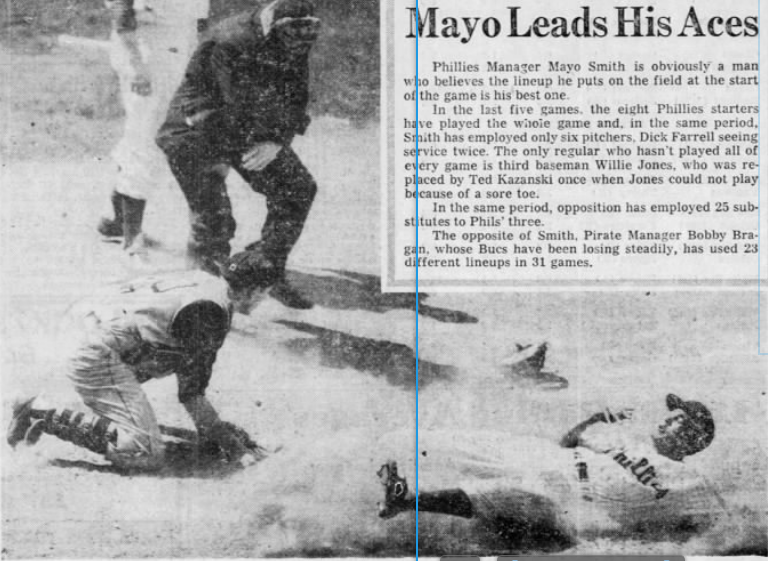
Chico Fernandez steals home, May 25, 1957.

The Tampa Bay Rays Manuel Margot's unsuccessful attempt to steal home against Clayton Kershaw, Austin Barnes and the Los Angeles Dodgers during the fourth game of the 2020 World Series was sure to get fans thinking back to the Dodger Jackie Robinson's successful steal against the Yankees in the eighth inning of Game 1 of the 1955 World Series. For this life-time Phillies fan though, I couldn't help but think back to the audacious steal of home executed by the Phils' new  shortstop Chico Fernandez on May 25, 1957 against the Pittsburgh Pirates. To be sure, this was not the World Series, and these were not two great teams facing off, but the newly acquired (from the Dodgers no less) Fernandez was making a name for himself as a spirited, slick -fielding, and dynamic presence on a team of aging Whiz Kids and never-would-be-kids that badly needed an infusion of excitement.


Let me set the scene. The game was played on a Saturday afternoon at Connie Mack Stadium in Philadelphia. The crowd of 22,414 was one of the largest of the season in the old park and the result of this being both a Ladies Day and Knothole Kids game (ladies and kids get in free). In the bottom of the fourth inning, with the Pittsburgh Pirates leading 4-3, the Phils rallied. Right-fielder Bob Bowman led off with a single and Fernandez, batting eighth, also singled, with Bowman,  going to third. That brought up Phils' pitcher Harvey Haddix and also brought out Buccos manager Bobby Bragan to make a pitching change. Left-hander Bob Smith was brought in to face the lefty swinging Haddix. Haddix struck out, but Richie Ashburn then singled on a hit and run to score Bowman, tie the game, and send Fernandez flying around to third. 

With the feisty Fernandez dancing off third, Granny Hamner took a called third strike. Fernandez, however, saw that the lefty Smith was paying close attention to the speedy Ashburn on first, but not checking at third. Phils' slugger Stan Lopata strode to the plate and as Smith came set, Chico took off. The flustered Smith hesitated and threw late to catcher Dick Rand, who could only trap the low pitch and watch as Fernandez slid safely across the plate with the go ahead run.  The home plate ump, Bill Baker flashed the safe sign and Fernandez rose, dusted himself off, and ran smiling to the home dugout to the waiting congratulations of his teammates and the delighted cheers of the crowd.

The play seemed to unnerve pitcher Smith, who threw ball two to Lopata, and then tossed up a cookie that Lopata deposited on the roof in left field. The Phils went on to win the game 8-6 and Chico Fernandez would go on to win a place in the hearts of Phillies fans everywhere. Headlines the next day, featured Lopata's blast, but also Chico's daring dash.

This was actually the second time Fernandez had tried to steal home in a Phillies uniform. Only a week earlier in St. Louis, Fernandez also beat the throw, but was tagged out when he failed to touch home plate on the way past. The steal of home became symbolic of the joy and abandon with which Fernandez played the game. That abandon often got him in hot water with the manager. Earlier in the season he was guilty of a number of baserunning gaffes, but when you are successful all is forgiven.

Through the years, Fernandez maintained his enthusiasm, but not his batting average. By 1959 , he was benched for newcomer Joe Koppe and in December he was traded to the Detroit Tigers. 

Fernandez managed to resuscitate his career with the Tigers and enjoyed three fairly productive seasons as the starting shortstop there. In Detroit he is also best remembered for a steal of home. On July 4, 1961 in the ninth inning against the New York Yankees at Yankee Stadium with the bases loaded, the game tied, and none other than slugger Rocky Colavito at the plate, Chico took off again. Yankees pitcher Rollie Sheldon threw home, a startled Colavito fell down trying to get out of the way, catcher John Blanchard lurched toward the plate and Chico executed a diving head-first slide, hitting the plate a split second before Blanchard's tag. It was ruled a triple steal with the other runners moving up as well.

The advisability of attempting to steal home with two out and the bases loaded in the ninth inning of a tie game with the team's most feared hitter at the plate might be questioned, but the Tigers won the game, vaulted past the Yankees into first place, and had a play to talk about for all-time, so why question Chico's strategy? It was pure Chico and pure entertainment.

Over his 6+ year major league career, Fernandez attempted to steal home six times and was successful three times. But successful or unsuccessful, Chico Fernandez proved that sometimes doing something a little crazy is just what the doctor ordered for a professional baseball team.


Saturday, September 19, 2020

Joe Lonnett's Miracle Month


If ever a man was central casting for the role of back-up catcher, it was Joe Lonnett. Lonnett played in parts of four seasons with the Philadelphia Phillies from 1956-1959, appearing in 143 games and compiling a microscopic .166 lifetime batting average. Throughout his injury riddled minor league career, Joe had shown he could be a solid .270 hitter. and he was a competent defensive backstop and popular guy in the clubhouse. On the major league level, however,  he rarely got the consistent playing time that might have allowed him to get the timing he needed to be a better hitter. That is until one month in July, 1957, when Joe enjoyed a kind of miracle month when he hit five of his career total of 6 home runs and flashed some of the talent of the player he might have been.

The month was set up by a June 28 right shoulder injury to regular Phillies catcher Stan Lopata. Lopata was a key member of a pretty weak Phillies offense and the injury appeared to many to be the death knell for the team's nascent pennant hopes. Into the pennant race stepped Joe, with a meager two dozen major league games worth of experience in his pocket, to fill the gap until Lopata could return. He responded well.

On July 1 with the Phils mired in a five game losing streak and trailing the lowly Pirates by 4-0, Joe's double started a five run eighth inning outburst that gave the Phils the win. Three days later on July 4th at home in Connie Mack Stadium, Joe celebrated Independence Day with the first home run of his major league career, a two-run  eighth inning shot off the Giants Al Worthington in a 6-2 Phils victory. The next day, Joe singled home a run in a 6-5 loss to the Dodgers and followed that one day later with an RBI double in Phil's win over the Dodgers, this time 9-4.

On July 7, Joe raised his average to .200 going 1 for 3 with a single, but more importantly saved the game with a defensive play. As Allen Lewis of the Philadelphia Inquirer described it, with Dodger runners on second and third, Lonnett took a throw from Granny Hamner at second base, blocked the plate with his left leg and tagged out the speedy Charley Neal with a sweep tag. He then wheeled and doubled up the slow reacting Duke Snider at first for a double play. The Phils eventually won the game 2-1.

Joe's second and third home runs came in the same series, July 11-13 against the Cubs. The Phillies won both games 3-1 and 5-2.  His improbable 4th home run in ten days came off Larry Jackson of the Cardinals on July 14, another Phillies win, 11-4. Joe was 2 for 2 with 2 RBIs, a walk and a sacrifice fly in the game.

Towards the end of July, Lopata was healthy again and Joe returned to his customary place on the bench, but he had one more moment of glory up his sleeve. On July 29, while catching a Robin Roberts shut-out of the Cubs in Wrigley Field, Joe hit his fifth home run of the month. This one was the most improbable of them all, an inside the park homer for the plodding catcher. Joe launched a long high drive down the left filed foul line that fell fair as Cubs left fielder Lee Walls crashed into the ivy covered wall. By the time Walls recovered and threw to relay man Ernie Banks, Joe was chugging home. His slide beat the ball by a whisper, knocking it away from catcher Charlie Silvera.

Thus ended Joe's miracle month. Every one of his home runs came in Phillies victories. His catching and his surprising offense had helped the Phillies stay afloat in the tight National League pennant race. Joe would hit only one more home run in his major league career, two-years later, on July 12, 1959. July, it seems, was his month.

Lonnett went on to have a long and distinguished coaching career, mostly with the Pittsburgh Pirates, where he earned a World Series ring as the third base coach with the "We Are Family" Pirates of 1979. He is remembered by all as a good man and a good baseball man. Dick Allen remembered him as his favorite coach. Former Pirate pitcher and broadcaster, Jim Rooker,  said of Joe, " There are people with big hearts, but Joe had a mega-heart. He was such a wonderful person." Joe died in 2011 at age 84.